Nathan Heller's recent piece in The New Yorker about MOOCs at Harvard is fantastic. It's not as long as it could be (I rarely say that about New Yorker articles), but it at least introduces so many of the difficult questions that MOOCs raise about pedagogy, learning, and the purpose of college. One of the professors who is taking part in the Great Harvard MOOC Experiment is Gregory Nagy, retooling his Core (now GenEd) course on the ancient Greek hero. Nagy has revamped his hour lectures to much shorter ones, complete with video clips and animation. It sounds fantastic, and I remember, when I taught in the Core, how highly regarded Professor Nagy's course was. But even the most charismatic, experienced lecturer is still giving a lecture. It's been demonstrated, again and again, that students don't learn very much from lectures. Furthermore, as InsideHigherEd reports, a new study proves that students don't learn any more from a charismatic lecturer than a dud (though they think the more charismatic lecturer to be a more effective teacher). Beyond that, students apparently aren't motivated to show up for lectures. Heller quotes Harvard professor and former dean Harry Lewis as saying:
Students, if all you're going to do is lecture at them, no longer see any reason to show up to be lectured at.
If elite R1 institutions are the pioneers of MOOC-land, beginning to survey and map out terrain, small liberal arts colleges are mostly looking at maps of terra incognita (here be dragons). Wesleyan is one of the first SLACs to partner with Coursera; Maria Bustillos has an amazing piece in The Verge about her experience in "The Ancient Greeks," taught by Wesleyan professor Andrew Szegedy-Maszak. She includes a conversation with Professor Szegedy-Maszak about the course. As with the HarvardX Greek hero MOOC, the lectures are apparently fantastic. But Bustillos is very clear that the MOOC demanded nothing of her as a student; it was one-way content coming at her. Without a way to interact meaningfully and in a sustained manner with other students and the professors, the course was like watching a really good documentary. Interestingly, the professor himself acknowledges this when considering how developing the MOOC will affect his other classes:
I'm supposed to teach the Greek history survey at Wesleyan this coming
fall, and I think that what I will do is to incorporate the course
lectures as part of the assignment, use them as a sort of introduction,
and then I'll have more class time to engage the students in discussion
of some of the interpretive problems, and issues of the sources, that
otherwise I would have to skim by. Here, the class is 80 minutes twice a
week; we were very strongly advised to keep the Coursera lectures
between 12-20 minutes.
The classroom discussion (or "close colloquy," as the Amherst College mission statement puts it) emerges here, and in Heller's article, as centrally important to a liberal arts education. Heller writes:
I had adopted again the double consciousness of classroom students: the strange transaction of watching someone who watches back, the eagerness to emanate support. Something magical and fragile was happening here, in the room. I didn't want to be the guy to break the spell.
As I've reflected back on the semester (and read my teaching evaluations), it seems to me that those moments of genuine shared conversation between students and faculty make an outsized impact on students. Modeling and fostering critical thinking, and showing students how rewarding and delightful it can be to have thoughtful, engaged intellectual conversations, is at the heart of what happens in the classroom. For example, one of the things I do as a teacher is draw attention to students' substitution of "I feel" when what they mean is "I think." This can be a difficult habit for them to break, but it gets us all thinking and talking about rhetorical strategies, the importance of vocabulary, and the many ways to approach a question or interpretation. I've heard, again and again, that this is one of the things that my students find thought-provoking and productive for their own conceptions of themselves as thinking (rather than feeling) beings. Likewise, the combination of reading, screening, discussion, and role-playing in my Medievalisms course got the students excited to learn from each other and also intellectually agile enough to make fascinating connections to all kinds of material. The final papers were imaginative, thoughtful, and analytical about everything from video games to "Kingdom of Heaven" to the potato.
Perhaps what MOOCs can do for the liberal arts curriculum is free us from the tyranny of content. If we can all accept that lectures are an imperfect way for students to learn (to learn either facts or skills), and that content itself is not as centrally important as it once was, then we might turn our attention in the classroom away from lecture and back toward close colloquy.
*This whole post doesn't even get into the many fantastic articles and blog posts on the issues of market forces, labor, and economic motives for MOOCs. So I shall just say that you should all read Aaron Bady on market forces and MOOCs, Susan Amussen and Allyson Poska over at Historiann on who benefits the most from MOOCs, and Kathleen Lowrey on the implications of MOOCs on labor practices and the pedagogical assumptions that MOOCs rest on.
Thursday, May 30, 2013


Thursday, May 23, 2013
Game of Thrones as Universal History
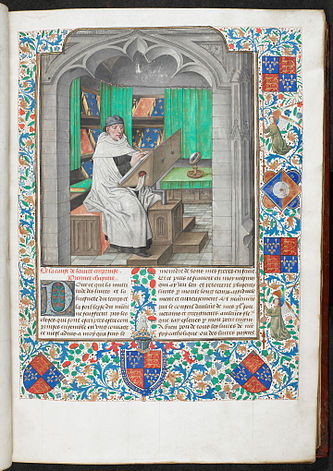 |
| Vincent of Beauvais writing his universal history. BL MS Royal 14 E.i |
These chronicles are a particular and rather weird genre. There is no overarching narrative (although they were often written to legitimate particular dynasties). Chronicles contain dozens, even hundreds, of characters, and they appear and then disappear with no fanfare. There are long stretches of description and exposition punctuated by shocking or terrible events (poisoning, beheading, treason, famine, war). Occasionally, the writer pauses for a digression...a love story, a convoluted plot, an accusation of sorcery. Chronicles end abruptly and often without any kind of denouement. And because universal histories cover synchronous events in different locales, the authors constantly need to signal that the next episode in the chronicle is happening contemporaneously with something else.
A Song of Ice and Fire is a universal history. Martin has created a world with an elaborate backstory and its own mythology. The books encompass the history of Westeros and include the dynastic tales of the Targaryens and the Andals. The shifting POV chapters ensure that the chronicle covers synchronous events. There are hundreds of characters, long stretches of description and exposition, digressions on sorcery or love or treason. Characters that we have gotten to know over hundreds of pages die suddenly...and the story keeps moving. This mirrors universal histories; someone is always getting shot with a stray arrow or choking on a plate of eels at the inopportune moment. Rains of blood, fiery portents, and magical occurrences appear in chronicles; Game of Thrones opens with wights and ends with the marvelous rebirth of dragons, and the dead stag and direwolf of the opening portend the fates of Robert Baratheon and Ned Stark.
The chronicle-nature of Game of Thrones accounts for its strengths and its weaknesses. It's what makes the show so rich and multi-layered, but it also means that there many characters and plots. It's hard to keep track of everyone, and it's also difficult to link the pieces into a larger narrative. So far, Benioff and Weiss are doing a good job, although I wonder how the show will change as the story gets even more complicated. It's also why there are so many digressions in the books (Meereen, anyone?). I'll be interested to see if GRRM will bring any closure or denouement to ASoIaF over the next two books, or if he'll just write "explicitus est liber" and be done with it.
Thursday, May 9, 2013
Further Tales from The Library
I had a rare treat this afternoon: I went to the brand, spanking-new Schoenberg Institute for Manuscript Studies at Penn. The space is gorgeous and fantastic for working; the library staff are helpful and knowledgeable; and the collection of scientific manuscripts is UNBELIEVABLE. Some of today's highlights included examining an early twelfth-century copy of Gerbert of Aurillac's introduction to geometry, the Isagogae geometriae. The manuscript has intralinear and marginal glosses, as well as manicula, in at least three different hands.
Another gem was a twelfth-century French copy of William of Conches' De philosophia mundi, with some fantastic diagrams, including this climate zone map. And further along, a monk took exception to the sections on procreation and childbearing.
 |
| Geometry is more fun with dragons. LJS 194, fol. 7v. |
 |
| The scribe wrote around a hole in the parchment, likely made during stretching. |
 | |
| A Macrobian climate zone map. LJS 384, fol. 15r. |
 |
| No ladyparts please, we're monks. LJS 384, fol. 16r. |
Tuesday, April 23, 2013
Notes from The Pedagogue's Desk
Several weeks ago, we began a new unit in the Medievalisms course that I'm teaching this semester. It's on fantasy and fan culture: First, the students watched an episode of Game of Thrones, read this fantastic review essay in the LRB, and did a bunch of internet research on the fansites and wiki sites around ASoIaF. Then they read Fantasy Freaks and Gaming Geeks by Ethan Gilsdorf. Ethan visited class and led a lively and productive conversation about nerd culture, medievalism, fantasy, and role-playing. The following day, Ethan gave a talk to the larger community about the links between college culture and fantasy medievalisms, and then designed and led an evening D&D class.
My co-professor and I are newbs to RPGs, tabletop or otherwise, and we were entirely uncertain, when we first designed the syllabus, how this part of the course would come together.
It was fantastic.
The first half of this unit, on Game of Thrones and fan culture, got students thinking about the fantasy genre and medievalism. It has been challenging, throughout the semester, to help the students move beyond making arguments about accuracy and authenticity (or fidelity). However, once "accuracy" is off the table, as with fantasy, they immediately started to see the different medievalisms at play. The students were able to take the conversation further when they discussed Ethan's book with him, and they were *amazing* at the D&D session. Every single student got really into it, even the skeptics, and they were thoughtful and incisive the next day. They discussed questions of gender, performance, community and expertise, and medievalism, and analyzed their own experiences with the quest that Ethan designed.
The moral of this story: Engage with what the students are interested in (all of the students are interested in medievalism, having read Harry Potter or watched LOTR; others are intense and frequent gamers or LARPers), and then bring in a really smart person to help you with what you don't know about.
My co-professor and I are newbs to RPGs, tabletop or otherwise, and we were entirely uncertain, when we first designed the syllabus, how this part of the course would come together.
It was fantastic.
The first half of this unit, on Game of Thrones and fan culture, got students thinking about the fantasy genre and medievalism. It has been challenging, throughout the semester, to help the students move beyond making arguments about accuracy and authenticity (or fidelity). However, once "accuracy" is off the table, as with fantasy, they immediately started to see the different medievalisms at play. The students were able to take the conversation further when they discussed Ethan's book with him, and they were *amazing* at the D&D session. Every single student got really into it, even the skeptics, and they were thoughtful and incisive the next day. They discussed questions of gender, performance, community and expertise, and medievalism, and analyzed their own experiences with the quest that Ethan designed.
The moral of this story: Engage with what the students are interested in (all of the students are interested in medievalism, having read Harry Potter or watched LOTR; others are intense and frequent gamers or LARPers), and then bring in a really smart person to help you with what you don't know about.
Sunday, April 21, 2013
Not Content
Recent articles and incisive blog posts about MOOCs, alongside few more recent news articles that present different ideas about the purpose of higher education in this country have vividly illustrated the shift to thinking about education as content and students as users. I don't have a lot to add to Historiann's fantastic close reading of the decision of Amherst faculty to turn down the opportunity to partner with EdX; however, it's notable that this story hit Inside Higher Ed just a few days before A. J. Jacobs review of MOOCs and Frank Bruni's column on the purpose of higher education both appeared in the NYT.
Bruni writes about the debates at the UT flagship campus in Austin: Is college intended to provide job training, or something else? This is an open question, as lawmakers and educators in Texas, Virginia, Oregon, and many other states are increasingly interested in providing job placement statistics and salary figures for graduates with different majors. But, as some high-profile educators have pointed out, judging the worthiness of a college education by immediate post-college graduate earnings is far too narrow a metric. A liberal arts education does more than train someone for a job; it gives young people the skills to envision and invent the jobs they want, and it helps them become better global citizens and community members. But this view can certainly seem like a luxury, given the high numbers of unemployment for people under 25 and ballooning student debt.
I don't think anyone working in higher education today is unaware--at least to some degree--of the many stresses on both private and public higher ed in this country, and the difficult choices they are going to force.* And I certainly think instructional technology can provide pedagogically exciting opportunities to meet some of these challenges and to democratize education. The Jacobs piece, however, exposes some of the major issues that MOOCs present: attrition, isolation, and the idea that education is the same as content-delivery. If that's the case, then why not just do away with MOOCs entirely, and just skip to Wikipedia and YouTube? This is a slight exaggeration, but I do think that, at its core, this idea of education seems to be based around a "content-provider" platform. Professors provide the content, which EdX, Udacity, etc. then provide to the user. Content is static, not dynamic (the lectures, once written, recorded, and produced once, can be essentially "syndicated" and repeated every year or two). The other tacit assumption that this model rests on is that teaching and learning are scalable. This, it seems to me, is what the Amherst faculty found most at odds with their mission to provide education "through close colloquy." The scalability of education that MOOCs promise is also part of the "content-provider" model: I can watch content on my tv, my computer, my tablet, and my phone, anywhere I go (Jacobs addresses this explicitly). Education through "close colloquy" between students and faculty isn't scalable, and it's not portable. How long before we see EdX or Coursera partnering with Comcast or Time-Warner? Has that already happened?
*Indeed, I recently talked to someone who'd been at a large meeting with the president of an extremely wealthy, extremely prestigious private university. When asked by an attendee what the president was optimistic or excited about w/r/t the future of higher education, the president chuckled bleakly.
Bruni writes about the debates at the UT flagship campus in Austin: Is college intended to provide job training, or something else? This is an open question, as lawmakers and educators in Texas, Virginia, Oregon, and many other states are increasingly interested in providing job placement statistics and salary figures for graduates with different majors. But, as some high-profile educators have pointed out, judging the worthiness of a college education by immediate post-college graduate earnings is far too narrow a metric. A liberal arts education does more than train someone for a job; it gives young people the skills to envision and invent the jobs they want, and it helps them become better global citizens and community members. But this view can certainly seem like a luxury, given the high numbers of unemployment for people under 25 and ballooning student debt.
I don't think anyone working in higher education today is unaware--at least to some degree--of the many stresses on both private and public higher ed in this country, and the difficult choices they are going to force.* And I certainly think instructional technology can provide pedagogically exciting opportunities to meet some of these challenges and to democratize education. The Jacobs piece, however, exposes some of the major issues that MOOCs present: attrition, isolation, and the idea that education is the same as content-delivery. If that's the case, then why not just do away with MOOCs entirely, and just skip to Wikipedia and YouTube? This is a slight exaggeration, but I do think that, at its core, this idea of education seems to be based around a "content-provider" platform. Professors provide the content, which EdX, Udacity, etc. then provide to the user. Content is static, not dynamic (the lectures, once written, recorded, and produced once, can be essentially "syndicated" and repeated every year or two). The other tacit assumption that this model rests on is that teaching and learning are scalable. This, it seems to me, is what the Amherst faculty found most at odds with their mission to provide education "through close colloquy." The scalability of education that MOOCs promise is also part of the "content-provider" model: I can watch content on my tv, my computer, my tablet, and my phone, anywhere I go (Jacobs addresses this explicitly). Education through "close colloquy" between students and faculty isn't scalable, and it's not portable. How long before we see EdX or Coursera partnering with Comcast or Time-Warner? Has that already happened?
*Indeed, I recently talked to someone who'd been at a large meeting with the president of an extremely wealthy, extremely prestigious private university. When asked by an attendee what the president was optimistic or excited about w/r/t the future of higher education, the president chuckled bleakly.
Saturday, April 6, 2013
The Dystopic Future of Education Is Here
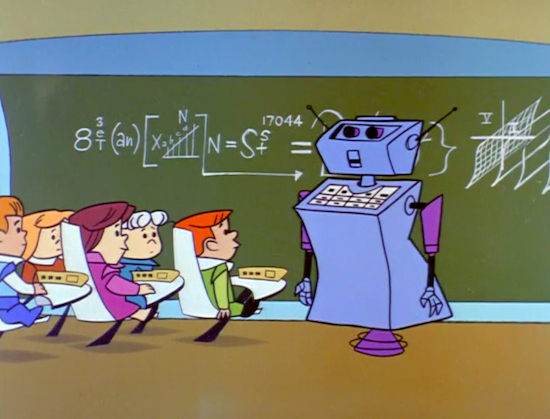
"The system then uses a variety of machine-learning techniques to train itself to be able to grade any number of essays or answers automatically and almost instantaneously.
The software will assign a grade depending on the scoring system created
by the teacher, whether it is a letter grade or numerical rank. It will
also provide general feedback, like telling a student whether an answer
was on topic or not."
It's true that I'm somewhat tempted by this; I'm looking at a very large stack of papers to grade this weekend. But this sounds like a bad idea for two reasons: The first is that offering feedback about whether a paper is "on topic or not" is not particularly helpful for a student who needs to learn critical thinking skills. Mastering a particular topic or some information is far less important than mastery of logic and rhetoric; additionally, the latter are ultimately transferable from one kind of task to another, unlike the former. The second reason is that I don't think the increased automation of education is a good idea. Or, put a different way, I don't think it's a good idea for learning anything other than basic content.
Not only is human-graded student work going out the window, but those entire pesky universities are, too. EdX is also teaming up with Pearson, the educational testing service, to offer proctored exams for certificate credit to MOOC enrollees. Yes, the for-profit education testing service is now going to be in the business of accrediting MOOCs for students who want to get academic credit. And the Minerva Project offers the promise of a "hybrid" model--MOOCs and a residential college experience. Pay for both experiences, but without getting as much as either has to offer by itself. The privatization of college education is here to stay.
Thursday, March 14, 2013
Game of Thrones Is Better on TV
I'm teaching a course on medievalism this semester, and one of things I've assigned is an episode of "Game of Thrones" (S1E7: "You Win Or You Die"). The books are too long to assign for a course that also covers a lot of other material, but I wanted the students to grapple with questions of adaptation; visual tropes of medievalism and high fantasy; and the presence of an interactive on-line community of fans and fan sites.
Adaptation (across media, time period, or country) is one of the through-lines of the course. Students read several different versions of the story of Merlin and Viviane, compare Chrétien de Troyes' Lancelot with Jerry Zucker's "First Knight," and look at medieval and contemporary stories of outlaws and crusaders. For our "Game of Thrones" and interactive fantasy unit, the students aren't reading any of the ASoIaF books, but they are digging deep into winteriscoming.net and other fan sites and wikis to research the characters they'll see in "You Win Or You Die." I hope that this will give them at least a basic introduction into the books and some of the choices that David Benioff and D. B. Weiss made when they adapted the books for HBO. I recently re-watched both seasons over again in preparation for this unit and feel even more strongly than I did before that the tv series is more interesting, more complicated, and more pleasurable than the book series.
There are a few different reasons for this. One has to do with the different media. The books are written in alternating third person POV, which gives the reader a limited view of the action and the other characters. A tv show can't do that. Although the show does focus on particular story lines or characters from episode to episode, it generally presents the action in omniscient third person POV (though there are some first-person POV camera angles). This means that characters whom we know (in the books) only from another character's POV (like Varys, Shae, or Jorah Mormont) become, instead, characters that we know just as well as Tyrion or Dany. This shift in perspective, combined with the talented cast and direction, makes the experience of the tv show richer. Martin isn't very effective at conveying the particularities of each character's interior life in writing. But the actors are *very* good. Jorah Mormont (Iain Glen), is embittered, protective, lethal, and a true believer in Dany's claim. Nikolaj Coster-Waldau made some specific choices as an actor to indicate Jamie Lannister's internal depths (and conflicts). This makes Jamie a much more compelling character than he is in the first two books of the series.
Another leg up that the tv show has over the books also has to do with the limitations of prose in general. Martin is a meticulous world-builder, but that requires an awful lot of description and exposition. Pages and pages of it. But the incredibly high production values on the HBO show mean that the art direction and set design can stand in for much of that description, and provide a richly inhabited and fully realized visual world. Sometimes the dragons look a little cheesy, but the Wall, Winterfell, and Pyke look fantastic. The limitations of Martin's prose, in particular, is another reason the tv show is better. The show's writers have condensed plots, dispensed with minor characters, and made the emotional resonances of the characters more complex. I think this is particularly true of a number of the women characters. It's not that Martin neglected Cersei, but the writers on the show have brought out her rage at being a pawn despite her considerable acumen, and this makes her villainy more plausible. She's a more nuanced character. Instead of the bland Jeyne Westerling, we get Talisa Maegyr of Volantis--an immigrant to Westeros out of conscience. It's also clear that Catelyn Stark has a canny mind for statecraft and diplomacy.
A lot of things still happen on the tv show, but the writers and producers make sure that the events always reveal something about the characters. Melisandre's shadow-assassin murders Renly, but the show gives us a sharp scene between Loras and Margery that illustrates Margery's pragmatism and Loras' anguish. Martin's books are like sprawling, paratactic medieval chronicles, but "Game of Thrones" is like a Victorian novel: it has narrative economy, coherence, and more richly developed characters. So, if you're not watching the show because you haven't read the books yet, skip the books and start watching.
Adaptation (across media, time period, or country) is one of the through-lines of the course. Students read several different versions of the story of Merlin and Viviane, compare Chrétien de Troyes' Lancelot with Jerry Zucker's "First Knight," and look at medieval and contemporary stories of outlaws and crusaders. For our "Game of Thrones" and interactive fantasy unit, the students aren't reading any of the ASoIaF books, but they are digging deep into winteriscoming.net and other fan sites and wikis to research the characters they'll see in "You Win Or You Die." I hope that this will give them at least a basic introduction into the books and some of the choices that David Benioff and D. B. Weiss made when they adapted the books for HBO. I recently re-watched both seasons over again in preparation for this unit and feel even more strongly than I did before that the tv series is more interesting, more complicated, and more pleasurable than the book series.
There are a few different reasons for this. One has to do with the different media. The books are written in alternating third person POV, which gives the reader a limited view of the action and the other characters. A tv show can't do that. Although the show does focus on particular story lines or characters from episode to episode, it generally presents the action in omniscient third person POV (though there are some first-person POV camera angles). This means that characters whom we know (in the books) only from another character's POV (like Varys, Shae, or Jorah Mormont) become, instead, characters that we know just as well as Tyrion or Dany. This shift in perspective, combined with the talented cast and direction, makes the experience of the tv show richer. Martin isn't very effective at conveying the particularities of each character's interior life in writing. But the actors are *very* good. Jorah Mormont (Iain Glen), is embittered, protective, lethal, and a true believer in Dany's claim. Nikolaj Coster-Waldau made some specific choices as an actor to indicate Jamie Lannister's internal depths (and conflicts). This makes Jamie a much more compelling character than he is in the first two books of the series.
Another leg up that the tv show has over the books also has to do with the limitations of prose in general. Martin is a meticulous world-builder, but that requires an awful lot of description and exposition. Pages and pages of it. But the incredibly high production values on the HBO show mean that the art direction and set design can stand in for much of that description, and provide a richly inhabited and fully realized visual world. Sometimes the dragons look a little cheesy, but the Wall, Winterfell, and Pyke look fantastic. The limitations of Martin's prose, in particular, is another reason the tv show is better. The show's writers have condensed plots, dispensed with minor characters, and made the emotional resonances of the characters more complex. I think this is particularly true of a number of the women characters. It's not that Martin neglected Cersei, but the writers on the show have brought out her rage at being a pawn despite her considerable acumen, and this makes her villainy more plausible. She's a more nuanced character. Instead of the bland Jeyne Westerling, we get Talisa Maegyr of Volantis--an immigrant to Westeros out of conscience. It's also clear that Catelyn Stark has a canny mind for statecraft and diplomacy.
A lot of things still happen on the tv show, but the writers and producers make sure that the events always reveal something about the characters. Melisandre's shadow-assassin murders Renly, but the show gives us a sharp scene between Loras and Margery that illustrates Margery's pragmatism and Loras' anguish. Martin's books are like sprawling, paratactic medieval chronicles, but "Game of Thrones" is like a Victorian novel: it has narrative economy, coherence, and more richly developed characters. So, if you're not watching the show because you haven't read the books yet, skip the books and start watching.
Subscribe to:
Posts (Atom)