I recently spent some time working in the Reading Room of the Morgan Library and Museum, examining M. 751, the Abrégé des histoires divines, a universal chronicle until about 1220.
It is always a pleasure to work at the Morgan. The staff is helpful and professional, the facilities are superb, and there's a lovely cafe on the main floor for a lunch break (not cheap, though). But the real treat was getting to spend the day with a 700 year-old manuscript. I can't provide pictures, alas, but it's a fairly small ms, on vellum, with about 125 folios. It was written in about 1300, in a northern French dialect in a casual bookhand that is mercifully easy to read.
The text is a mash-up of the Bible, ancient history, political history, and ecclesiastical history. I'd just finished reading Gabrielle Spiegel's Romancing the Past, which is about northern French and Flemish vernacular histories in the thirteenth century, and the way that the patrons of those histories used them to legitimate their claims to authority. I've seen universal chronicles before, but it this time it all came together for me. The chronicle starts with Genesis, covers the Old and New Testaments, Troy and the founding of Rome, the Caesars and Roman emperors, the popes and the patriarchs, the Merovingians and Carolingians, the kings of England and the rulers of Northumberland, and the dukes of Normandy--all interspersed with one another in rough chronological order. So, after several pages on the patriarchs of Jerusalem, there's a switch with the thirteenth-century equivalent of "meanwhile, back at the ranch" ("Ore revient lestoire des ss papes").
The best is that there's a miniature on virtually every folio. Most of them have gold leaf backgrounds and accents, and the facial expressions are hilarious and precise. If you only looked at the miniatures as you turned the leaves you'd get a very particular view of medieval historiography: one violent act after another. Kings and holy men are poisoned, impaled, beheaded, dismembered, eaten by beasts, and smothered. Warriors clash on horseback and on foot, wielding swords, maces, and clubs. Evil kings betray their kin and counselors, demonstrating their perfidy with their crossed legs. The images that aren't violent are that much more arresting for their scarcity: Augustine teaches his students, some of whom look realistically bored or skeptical. The Virgin looks happy and tired with her newborn baby, as a curious ox and ass peer over the partition from their stall.
Next time...a sorcerer-pope who finds treasure and divines the future!
Wednesday, February 23, 2011


Tuesday, February 15, 2011
How about a nice game of chess?

No, I want to play thermo-nuclear war.
Day 1 of the newest pop-culture AI experiment: Man vs. Machine on 'Jepoardy!'
Didn't I already do this in my friend's basement in 1989? I didn't have Nintendo, but my friend did, and we use to play for hours.
Anyhoo, the whole thing was a bit of a snooze-fest. Watson, the IBM supercomputer, tied with one of the super-champs, Brad Rutter, for $5000. Watson's not a real supercomputer, but a series of ten networked servers, and this commentator wonders why the super-champs couldn't have access to other brains, like in "Who Wants to Be A Millionaire?" Watson made some boneheaded mistakes, blurting out bizarre answers just like the human contestants do.
But here's the thing: Would it really be news to anyone if a machine with thousands of terabytes of RAM could answer trivia questions faster than a person? It just doesn't seem that exciting, especially since my PC usually answers questions faster than I can. But here's an idea: a computer that can play multiple people in poker.

In the meantime...the earliest programmable machine? Probably
the Antikythera Mechanism, an astronomical calculator built over a century before the birth of Jesus.
Wednesday, February 9, 2011
How Did I Miss This?
The trebuchet is back!!! Mexican gangsters used one to fling Mary Jane over the border into Arizona.
I wonder if they learned how to build one by watching Nova:
I wonder if they learned how to build one by watching Nova:
Monday, January 31, 2011
Creative Anachronism
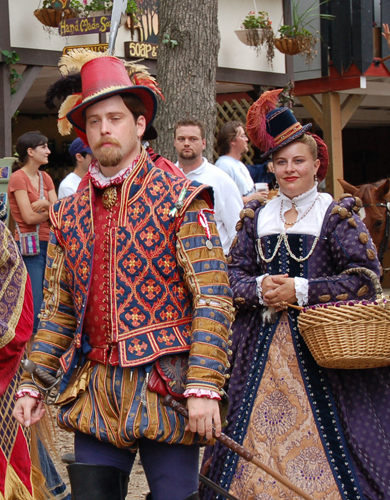 Ron Patterson, the man jointly responsible for creating the first Renaissance Fair(e), died a few weeks ago. From a small backyard event, the idea grew into a multi-billion dollar industry, demonstrating the appeal of tights, doublets, ruffs, chain mail, and jousting for millions of Americans.
Haven't been to a Renaissance Fair? Then you're probably in the minority--there are hundreds of them held throughout the country every year. A pal of mine, Ethan Gilsdorf, wrote an excellent book about neo-medievalism (LARPing, Ren Faires, the CSA, MMORPGs like World of Warcraft, and the Tolkien films) that makes the point that these activities are the mainstream. My guess is that Renaissance Fairs are one of the most easily accessible of this kind of entertainment/hobby for most people, as they're ubiquitous, fun, and family-friendly (I insisted that my mother take me to the Maryland Renaissance Festival when I was a teenager).
Can't get to a Ren Faire anytime soon? You could always go to Medieval Times, although that could easily go awry:
Thursday, January 27, 2011
Social Network Anxiety, or We Are All Courtiers
It's Oscar season!
Both Sherry Turkle's new book, Alone Together, and "The Social Network" seem to have the same humanist viewpoint and message: social networking sites and the machines that we use to "keep in touch" are tools that we use to fake intimacy, treat each other like objects, and obsess over our self-presentation.
In "The Social Network," we meet Mark as he is utterly failing to have any kind of face-to-face human connection with his girlfriend, Erica.
His response to her break-up, and her assertion that he's an asshole, is to take the intimate details he knows about her and share them with his blog readers. His readers form a community who provide Mark with a way for faux-intimacy--by sharing intimate details and personal thoughts. At the same time, Mark builds a program that allows men to treat women like objects (or farm animals) and laugh.
And then at the end, Mark, the billionaire who could buy Mt. Auburn Street and turn the Phoenix into his billiard room, is friendless and alone, engrossed in his creation--the site where we can all be friends.
Turkle and others have pointed out that sites like Facebook are ways that people develop and present their personae. The teenagers that Turkle talks to about these sites are completely aware that they're presenting themselves as characters; that is, they don't mistake their on-line profiles for their truest or most vulnerable selves. But Turkle's point, and Aaron Sorkin's and David Fincher's, I think, is that true intimacy and human connection happens when we interact with people with whom we can be a person, not a persona. Mark and Eduardo's obsession with final clubs is a way to get elite status and be "cool," a way to take on a different persona, in the hopes that it will transform their personalities. At the end, Mark, told by Erica that his nerd persona is overshadowed by his asshole essence, gets told by another pretty lady that his assholism is just his persona--he's just trying too hard to be a jerk.
Perhaps Turkle's and Sorkin/Fincher's viewpoints are humanist in the historical sense, too, arguing that the social network is a kind of semi-public, courtly sphere in which we carefully curate our selves. Sprezzatura and Renaissance self-fashioning, welcome back!
Both Sherry Turkle's new book, Alone Together, and "The Social Network" seem to have the same humanist viewpoint and message: social networking sites and the machines that we use to "keep in touch" are tools that we use to fake intimacy, treat each other like objects, and obsess over our self-presentation.
In "The Social Network," we meet Mark as he is utterly failing to have any kind of face-to-face human connection with his girlfriend, Erica.
His response to her break-up, and her assertion that he's an asshole, is to take the intimate details he knows about her and share them with his blog readers. His readers form a community who provide Mark with a way for faux-intimacy--by sharing intimate details and personal thoughts. At the same time, Mark builds a program that allows men to treat women like objects (or farm animals) and laugh.
And then at the end, Mark, the billionaire who could buy Mt. Auburn Street and turn the Phoenix into his billiard room, is friendless and alone, engrossed in his creation--the site where we can all be friends.
Turkle and others have pointed out that sites like Facebook are ways that people develop and present their personae. The teenagers that Turkle talks to about these sites are completely aware that they're presenting themselves as characters; that is, they don't mistake their on-line profiles for their truest or most vulnerable selves. But Turkle's point, and Aaron Sorkin's and David Fincher's, I think, is that true intimacy and human connection happens when we interact with people with whom we can be a person, not a persona. Mark and Eduardo's obsession with final clubs is a way to get elite status and be "cool," a way to take on a different persona, in the hopes that it will transform their personalities. At the end, Mark, told by Erica that his nerd persona is overshadowed by his asshole essence, gets told by another pretty lady that his assholism is just his persona--he's just trying too hard to be a jerk.
Perhaps Turkle's and Sorkin/Fincher's viewpoints are humanist in the historical sense, too, arguing that the social network is a kind of semi-public, courtly sphere in which we carefully curate our selves. Sprezzatura and Renaissance self-fashioning, welcome back!
Friday, January 21, 2011
Kells Bells!
 I recently watched "The Secret of Kells" . It's an animated feature about the Book of Kells, a late-eighth century illuminated Gospel book and one of the most widely-known medieval manuscript books in the world. At Kells, in Ireland, Young Brendan, nephew of Abbot Cellach, is supposed to be helping his uncle build the fortifications around their monastery/town, but he'd rather contemplate the wonders of the scriptorium and run errands for Brother Aidan, a master illuminator.
Brother Aidan is a refugee from the Vikings, who attacked his monastery on Iona and killed everyone who couldn't escape. Abbot Cellach knows the Northmen will be coming to Ireland next, and he is fiercely determined to build a wall around his monastery that will keep out the marauders. Cellach is a pragmatist and a planner, and he hopes to shepherd his flock to safety in the face of the invasions. Aidan, a survivor, knows that nothing can keep the Vikings at bay, and instead focuses on his work--illuminating the Gospel--as a way to create something enduring that will bring light and hope to others. Brendan, a budding illuminator, gladly helps Aidan, and defies his uncle and abbot by going outside of the walls to find materials to make ink.
In the forest Brendan meets Ainslie, a fairy, who is able to talk to the animals and make the terrifying forest seem more hospitable. She takes him under her wing, shows him the forest and gets him what he needs, even at significant risk to herself. (This film has a few parallels to that other encounter narrative of 2009: "Avatar.") Ainslie's family have, it seems, been killed by (Christian) settlers Crom Cruach, the big bad who lives in the forest, but she doesn't hold this against Brendan (in his little monk's habit), even when he puts her in danger--repeatedly--for the sake of the Book. I'd have told him to take a hike.
The animation is enchanting. Abbott Cellach looks like a Byzantine ikon, with his red hair, high cheekbones, and long nose. The Vikings were terrifying, although they did remind me of the Bugs Bunny classic, What's Opera, Doc? The animators did a great job of making the animal and plant motifs in the Book of Kells visually coherent and part of the landscape of the forest around the monastery. And the moment when the Abbott sees the finished book is quite powerful. The animation jumps out of the screen (despite being in 2-D)--the intricacies of the designs glimmer and turn, making the entire page into a holistic organism.
That said, I can't get behind the "How the Irish Saved Civilization" slant of the film. Yes, the Vikings were terrifying marauders. And yes, it's nice to see a film that celebrates the importance of learning and books. But it's never made clear why "the people" would rather have a beautiful book to give them hope than stronger fortifications. Is it because they're Irish and a naturally bookish and literary people? And I thought that the parallels between Christian monks and pagan Vikings could have been better fleshed out: The Vikings have no respect for Christian symbols or human life and the Christians (esp. the monks) have--according to our fairy guide--no respect for nature, fairies, or the symbols and beliefs of the people who came before them.
Tuesday, January 18, 2011
The Future of Robots
The Chronicle of Higher Ed. has an interview with Sherry Turkle about her most recent book, Alone Together. Turkle's new book is partially about robots but more broadly about the different electronic devices that keep us "turned on" and "plugged in," as well as social networking sites. According to the interviewer, the takeaway of the new book (which I haven't read) seems to be that modern life is exhausting and that these "time-saving machines" suck out our brains and turn us into unsociable husks. I suspect that Turkle's book is actually a bit more nuanced than that, if her previous monographs are any yardstick.
But I was interested in the interviewer's account of the ethnographic work that Turkle and her colleagues have done in documenting the encounters between humans and human-like machines. In particular, robots that are designed to mimic and elicit emotional responses come under specific scrutiny. Is it ethical to allow children to form emotional bonds with machines that will never truly reciprocate them?
One of the things that I find so interesting about these questions is that they demonstrate how the definition of human behavior keeps changing. First, it was that we use tools. Then, once it was discovered that other animals use tools quite well, it was that humans have specific capacities for speech. Then, it was that humans have a particular capacity for intelligence. But once Deep Blue beat Gary Kasparov at chess, that changed. Now it's all about emotion. Machines don't care if they've won or lost a chess match, but people do. (Presumably Kasparov did, although he may have laughed all the way to the bank.) But when robots are programmed to feign emotion, and to elicit strong emotional bonds from humans, something seems amiss. I'm not sure that anything is actually amiss--is it really worse to form an emotional bond with a machine, only to discover that it can't reciprocate than it is to form an emotional bond with another person, only to discover that s/he is a sociopath or a narcissist?
But, once again: this isn't new. In a twelfth-century romance, Floire et Blancheflor, the two main characters are in love, but are separated by circumstance and fortune. Blancheflor is shipped away to a faraway court, but Floire is told that she has died. So, in her honor, he erects a tomb, complete with moving, speaking, breathing statues of him and Blancheflor. The statues kiss each other and caress each other, and say to each other, "I love you more than any living thing."
Robots have been a way for humans to work out the definitions of human behavior and the distinctions between human and Other. Those moments of the uncanny, when robots or dolls "come alive," are unsettling because they reveal that there isn't a bright line, just a blurry one.
UPDATE: Alone Together was reviewed in the Sunday NYT Book Review. It makes clear the connection between the two parts of Turkle's book (alluded to in the interview above): how we humanize objects, and how we objectify each other.
But I was interested in the interviewer's account of the ethnographic work that Turkle and her colleagues have done in documenting the encounters between humans and human-like machines. In particular, robots that are designed to mimic and elicit emotional responses come under specific scrutiny. Is it ethical to allow children to form emotional bonds with machines that will never truly reciprocate them?
One of the things that I find so interesting about these questions is that they demonstrate how the definition of human behavior keeps changing. First, it was that we use tools. Then, once it was discovered that other animals use tools quite well, it was that humans have specific capacities for speech. Then, it was that humans have a particular capacity for intelligence. But once Deep Blue beat Gary Kasparov at chess, that changed. Now it's all about emotion. Machines don't care if they've won or lost a chess match, but people do. (Presumably Kasparov did, although he may have laughed all the way to the bank.) But when robots are programmed to feign emotion, and to elicit strong emotional bonds from humans, something seems amiss. I'm not sure that anything is actually amiss--is it really worse to form an emotional bond with a machine, only to discover that it can't reciprocate than it is to form an emotional bond with another person, only to discover that s/he is a sociopath or a narcissist?
But, once again: this isn't new. In a twelfth-century romance, Floire et Blancheflor, the two main characters are in love, but are separated by circumstance and fortune. Blancheflor is shipped away to a faraway court, but Floire is told that she has died. So, in her honor, he erects a tomb, complete with moving, speaking, breathing statues of him and Blancheflor. The statues kiss each other and caress each other, and say to each other, "I love you more than any living thing."
Robots have been a way for humans to work out the definitions of human behavior and the distinctions between human and Other. Those moments of the uncanny, when robots or dolls "come alive," are unsettling because they reveal that there isn't a bright line, just a blurry one.
UPDATE: Alone Together was reviewed in the Sunday NYT Book Review. It makes clear the connection between the two parts of Turkle's book (alluded to in the interview above): how we humanize objects, and how we objectify each other.
Subscribe to:
Posts (Atom)