Ron Patterson, the man jointly responsible for creating the first Renaissance Fair(e), died a few weeks ago. From a small backyard event, the idea grew into a multi-billion dollar industry, demonstrating the appeal of tights, doublets, ruffs, chain mail, and jousting for millions of Americans.
Haven't been to a Renaissance Fair? Then you're probably in the minority--there are hundreds of them held throughout the country every year. A pal of mine, Ethan Gilsdorf, wrote an excellent book about neo-medievalism (LARPing, Ren Faires, the CSA, MMORPGs like World of Warcraft, and the Tolkien films) that makes the point that these activities are the mainstream. My guess is that Renaissance Fairs are one of the most easily accessible of this kind of entertainment/hobby for most people, as they're ubiquitous, fun, and family-friendly (I insisted that my mother take me to the Maryland Renaissance Festival when I was a teenager).
Can't get to a Ren Faire anytime soon? You could always go to Medieval Times, although that could easily go awry:
Both Sherry Turkle's new book, Alone Together, and "The Social Network" seem to have the same humanist viewpoint and message: social networking sites and the machines that we use to "keep in touch" are tools that we use to fake intimacy, treat each other like objects, and obsess over our self-presentation.
In "The Social Network," we meet Mark as he is utterly failing to have any kind of face-to-face human connection with his girlfriend, Erica.
His response to her break-up, and her assertion that he's an asshole, is to take the intimate details he knows about her and share them with his blog readers. His readers form a community who provide Mark with a way for faux-intimacy--by sharing intimate details and personal thoughts. At the same time, Mark builds a program that allows men to treat women like objects (or farm animals) and laugh.
And then at the end, Mark, the billionaire who could buy Mt. Auburn Street and turn the Phoenix into his billiard room, is friendless and alone, engrossed in his creation--the site where we can all be friends.
Turkle and others have pointed out that sites like Facebook are ways that people develop and present their personae. The teenagers that Turkle talks to about these sites are completely aware that they're presenting themselves as characters; that is, they don't mistake their on-line profiles for their truest or most vulnerable selves. But Turkle's point, and Aaron Sorkin's and David Fincher's, I think, is that true intimacy and human connection happens when we interact with people with whom we can be a person, not a persona. Mark and Eduardo's obsession with final clubs is a way to get elite status and be "cool," a way to take on a different persona, in the hopes that it will transform their personalities. At the end, Mark, told by Erica that his nerd persona is overshadowed by his asshole essence, gets told by another pretty lady that his assholism is just his persona--he's just trying too hard to be a jerk.
Perhaps Turkle's and Sorkin/Fincher's viewpoints are humanist in the historical sense, too, arguing that the social network is a kind of semi-public, courtly sphere in which we carefully curate our selves. Sprezzatura and Renaissance self-fashioning, welcome back!
I recently watched "The Secret of Kells" . It's an animated feature about the Book of Kells, a late-eighth century illuminated Gospel book and one of the most widely-known medieval manuscript books in the world. At Kells, in Ireland, Young Brendan, nephew of Abbot Cellach, is supposed to be helping his uncle build the fortifications around their monastery/town, but he'd rather contemplate the wonders of the scriptorium and run errands for Brother Aidan, a master illuminator.
Brother Aidan is a refugee from the Vikings, who attacked his monastery on Iona and killed everyone who couldn't escape. Abbot Cellach knows the Northmen will be coming to Ireland next, and he is fiercely determined to build a wall around his monastery that will keep out the marauders. Cellach is a pragmatist and a planner, and he hopes to shepherd his flock to safety in the face of the invasions. Aidan, a survivor, knows that nothing can keep the Vikings at bay, and instead focuses on his work--illuminating the Gospel--as a way to create something enduring that will bring light and hope to others. Brendan, a budding illuminator, gladly helps Aidan, and defies his uncle and abbot by going outside of the walls to find materials to make ink.
In the forest Brendan meets Ainslie, a fairy, who is able to talk to the animals and make the terrifying forest seem more hospitable. She takes him under her wing, shows him the forest and gets him what he needs, even at significant risk to herself. (This film has a few parallels to that other encounter narrative of 2009: "Avatar.") Ainslie's family have, it seems, been killed by (Christian) settlers Crom Cruach, the big bad who lives in the forest, but she doesn't hold this against Brendan (in his little monk's habit), even when he puts her in danger--repeatedly--for the sake of the Book. I'd have told him to take a hike.
The animation is enchanting. Abbott Cellach looks like a Byzantine ikon, with his red hair, high cheekbones, and long nose. The Vikings were terrifying, although they did remind me of the Bugs Bunny classic, What's Opera, Doc? The animators did a great job of making the animal and plant motifs in the Book of Kells visually coherent and part of the landscape of the forest around the monastery. And the moment when the Abbott sees the finished book is quite powerful. The animation jumps out of the screen (despite being in 2-D)--the intricacies of the designs glimmer and turn, making the entire page into a holistic organism.
That said, I can't get behind the "How the Irish Saved Civilization" slant of the film. Yes, the Vikings were terrifying marauders. And yes, it's nice to see a film that celebrates the importance of learning and books. But it's never made clear why "the people" would rather have a beautiful book to give them hope than stronger fortifications. Is it because they're Irish and a naturally bookish and literary people? And I thought that the parallels between Christian monks and pagan Vikings could have been better fleshed out: The Vikings have no respect for Christian symbols or human life and the Christians (esp. the monks) have--according to our fairy guide--no respect for nature, fairies, or the symbols and beliefs of the people who came before them.
The Chronicle of Higher Ed. has an interview with Sherry Turkle about her most recent book, Alone Together. Turkle's new book is partially about robots but more broadly about the different electronic devices that keep us "turned on" and "plugged in," as well as social networking sites. According to the interviewer, the takeaway of the new book (which I haven't read) seems to be that modern life is exhausting and that these "time-saving machines" suck out our brains and turn us into unsociable husks. I suspect that Turkle's book is actually a bit more nuanced than that, if her previous monographs are any yardstick.
But I was interested in the interviewer's account of the ethnographic work that Turkle and her colleagues have done in documenting the encounters between humans and human-like machines. In particular, robots that are designed to mimic and elicit emotional responses come under specific scrutiny. Is it ethical to allow children to form emotional bonds with machines that will never truly reciprocate them?
One of the things that I find so interesting about these questions is that they demonstrate how the definition of human behavior keeps changing. First, it was that we use tools. Then, once it was discovered that other animals use tools quite well, it was that humans have specific capacities for speech. Then, it was that humans have a particular capacity for intelligence. But once Deep Blue beat Gary Kasparov at chess, that changed. Now it's all about emotion. Machines don't care if they've won or lost a chess match, but people do. (Presumably Kasparov did, although he may have laughed all the way to the bank.) But when robots are programmed to feign emotion, and to elicit strong emotional bonds from humans, something seems amiss. I'm not sure that anything is actually amiss--is it really worse to form an emotional bond with a machine, only to discover that it can't reciprocate than it is to form an emotional bond with another person, only to discover that s/he is a sociopath or a narcissist?
But, once again: this isn't new. In a twelfth-century romance, Floire et Blancheflor, the two main characters are in love, but are separated by circumstance and fortune. Blancheflor is shipped away to a faraway court, but Floire is told that she has died. So, in her honor, he erects a tomb, complete with moving, speaking, breathing statues of him and Blancheflor. The statues kiss each other and caress each other, and say to each other, "I love you more than any living thing."
Robots have been a way for humans to work out the definitions of human behavior and the distinctions between human and Other. Those moments of the uncanny, when robots or dolls "come alive," are unsettling because they reveal that there isn't a bright line, just a blurry one.
UPDATE: Alone Together was reviewed in the Sunday NYT Book Review. It makes clear the connection between the two parts of Turkle's book (alluded to in the interview above): how we humanize objects, and how we objectify each other.
The NYT reported that the late Pope John Paul II is going to be beatified this spring.Vatican investigators (doctors, theologians, canon lawyers, scientists) have determined that JP2 interceded two months after his death to miraculously cure a nun of Parkinson's disease.
Here's the best part:
The nun has said she felt reborn when she woke up two months after John Paul died, cured of the disease that had made walking, writing and driving a car nearly impossible. She and her fellow sisters of the Congregation of Little Sisters of Catholic Maternity Wards had prayed to John Paul, who also suffered from Parkinson's.
Aside from the fact that this is a great mainstream demonstration that faith healing remains a thriving therapeutic system--something that I have to remind my students of every year--this is a fantastic example of the elasticity of the concept of miracle cure. Whenever I teach courses on medieval medicine and healing, my students often initially expect that a miracle cure will be immediate, total, and irreversible. They are astonished (and skeptical) when they learn that patients and supplicants had elastic ideas about miracle cures. While there are plenty of examples of dramatic, overnight cures at shrines (often characterized by copious amounts of blood, pus, or other bodily fluids, or loud noises), it's not uncommon for people to report miraculous cures that happened months after a visit to a shrine or prayers. Sometimes they were what we might consider partial (for example, decreased frequency or intensity of headaches) or short-term.
From the article, it seems as though Sister Marie Simon-Pierre and her fellow sisters prayed to JP2 for a cure for some time. The procedures for verifying and ratifying miracles are stricter and more centralized than in medieval Europe, but the fact that Sister Marie Simon-Pierre was cured two months after the former pope's death demonstrates that patients still have more expansive ideas about what constitutes a cure (and when) than we might expect.
Apparently, Sarah Palin spoke out today, denouncing those who've criticized her for (or just questioned) her perceived role in the assassination attempt and mass murder in Arizona over the weekend, and accusing journalists and pundits of a "blood libel."
Just to be perfectly clear: "Blood libel" was an accusation leveled against Jews living in medieval Europe that they ritually murdered Christian children and used their blood in religious rites. It is a specific thing--a real thing--and it has formed one of the main justifications for anti-Semitic violence and the annihilation of Jews in Europe for a millennium. It does not mean "making someone a scapegoat." Just because the concept of "blood libel" rests on a false claim, it does not mean "to make a false claim."
The claim that Jews murdered Christian children and used their blood appears first in England in the twelfth century, but was more broadly disseminated by Chaucer. The Prioress' Tale is about the murder of a Christian child by Jews and mentions the legend Little St. Hugh of Lincoln. This became one of the most well-known and oft-cited examples of Jewish ritual murder, and the Jews were eventually expelled from England in 1290, after almost a century of violent pogroms.
Here's a riddle: So, now that a public figure (publicly Christian and evangelical in ideology) claims to be the victim of the most pernicious kind of anti-Semitism, in response to questions about the effect that her political rhetoric may have played in the assassination attempt of Arizona's first (and only) Jewish Congressional representative, who do you think Glenn Beck will accuse of being like the Nazis? Will it be:
1. Sarah Palin 2. Congress 3. The Jewish-controlled mainstream media 4. President Obama
It seems like every week I get sent another email about universities in the US, UK, or Canada cutting vital humanities positions or entire departments. While it's probably true that I was completely and willfully blind to this before I had a steady paying job in academia, it does seem like the recent Global Financial Apocalyp$e has hastened the various cuts and also ramped up anxiety amongst humanities and humanistic social science scholars about these cuts (or threatened cuts).
Although I'm still (continually?) trying to untangle the many skeins of this issue that appear in appeals to petition, blog posts, op-eds, and journal articles, I'm certain about one thing. It's time to stop using the language of cost-effectiveness and the logic of the market to talk about the humanities and humanities education (this goes for the humanistic social sciences, too). Aside from the fact that it's now been proven untrue that humanities departments lose money, it's also beside the point. While humanities scholars may need to think more broadly about what they hope to convey to students (content or approach--or both?) and everyone needs to just get over that historical blip of the Cold War period when students at American universities were majoring in the humanities and every university could support tons of PhD students and professors got jobs without having to interview for them and tenure without having to write books and could have awesome upper-middle class lives on a professor's salary and manna fell from heaven and the students were all brilliant and everyone had more hair and more sex and more social conscience, the humanities offer something unquantifiable and irreplaceable to society and to young people.
Let's be bold and unapologetic about that.
Why has it been so difficult over the past few decades for humanities scholars to say that? I'm not a Pollyanna, and I know that universities need money--a lot of it--to function. But I really do think that once we start talking about how cost-effective the humanities are, we've already lost the argument and are instead just haggling over the terms of our capitulation. By the same token, I get so frustrated whenever I hear scholars who refuse to talk about the utility of their research--or even their teaching--as though it is or should be self-evident. If nothing else, haven't we (those among us who work in the humanities) all learned in graduate school that very few things are self-evident, and that framing, interpretation, first principles, evidence, and discursive vocabulary are paramount?
*** On a related note: Incoming president of the AHA Tony Grafton has a call to arms in the most recent issue of Perspectives [sub. req'd.]. Thanks to Historiann for excerpting it. The comments (including responses from Grafton) are also worth reading. One of the main points from Historiann and the commenters is that humanities professors are often described in the NYT and WaPo as unwilling (or unable) to teach undergraduates, resentful of anything that takes time away from esoteric research subjects, and extremely well-compensated for their "work." This is not what most college professors look like. (In fact, are there any who look like this?)
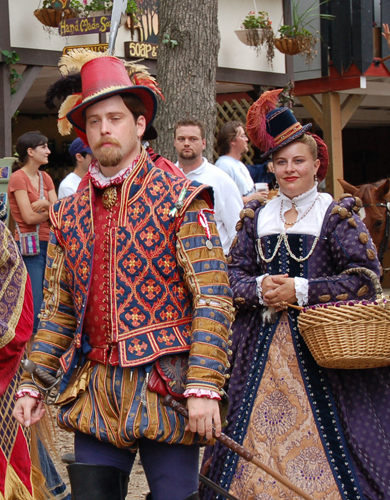 Ron Patterson, the man jointly responsible for creating the first Renaissance Fair(e), died a few weeks ago. From a small backyard event, the idea grew into a multi-billion dollar industry, demonstrating the appeal of tights, doublets, ruffs, chain mail, and jousting for millions of Americans.