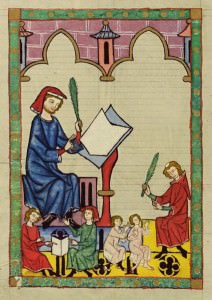
The humanities are in crisis! The crisis seems to be that the number of students who choose to study humanities subjects in college is in steep decline, as more students pursue majors in professional fields, like business, or STEM subjects, because these subjects are widely seen by students to be better job training. Some argue that this is because our society has devalued creative and culturally generative work.
To some, the narrow focus on employment and earnings is cause for lament and alarm. Others suggest that the decline is overstated, and that the humanities had a brief, anomalous post-war period of popularity.
There are, I imagine, as many suggestions for how to reverse this crisis as there are proposed reasons for its cause. I merely want to point out that this brief "golden age" of interest in the humanities, followed by a period of greater interest in professional training has happened before...at the outset of the first universities in Europe. In the twelfth century, the great cathedral schools at Chatres and Orléans placed particular emphasis on ancient literature and neoplatonist philosophy.
In these places, "the spirit of a real humanism showed itself in an enthusiastic study of ancient authors and in the production of Latin verse of a really remarkable quality."* But this humanistic renaissance was ultimately short lived,
as interest in the science of logic and the professional fields of law and medicine prevailed over interest in literature and philosophy. John of Salisbury, in the late twelfth century, complained that the logic masters knew almost nothing of literature. Fifty years later, Henri d'Andeli, a French poet, wrote that "Logic has the students, whereas Grammar [literature] is reduced in numbers, Civil Law rode gorgeously and Canon Law rode haughtily ahead of all the other arts."* Medieval is the new modern, people!
* Taken from C. H. Haskins, The Rise of Universities, ch. 2.
I've been doing some sifting through the year's news stories about robotics and robots to do a round-up post. But then I came across Lewis Black's segment on last night's Daily Show and thought, why bother?
I recently started learning something new:
chess.
 |
| The Lewis Chessmen. |
I never played it, I didn't know anyone who played it, and my total exposure to chess came from books and films in which people played chess (see: Searching for Bobby Fischer, Fresh, The Lymond Chronicles (especially Pawn in Frankincense), The Americans, Cairo Time, WarGames, The West Wing, etc.). In the cultural artifacts that introduced me to the game, it was always heralded as something really hard. When a character plays chess in a story, it tells the audience that the person (Fresh, Jed Bartlet, or Francis Crawford) playing is always several steps ahead of the people around them. Chess players think ahead, they can strategize, they can "see the whole board." And the mathematical nature of chess, especially (so I'm told) at its highest levels, lends itself to computational technology. (I vividly remember the Kasparov-Deep Blue matchup.)
But I confess that I'm confused about how and why chess became a yardstick for intelligence and, in some cases, for humanity, insofar as "human intelligence" is a proxy for what makes us uniquely human. Humans have been building calculating machines for millennia--even before chess was invented. Why is it that the element of human intelligence that is the *easiest* to reproduce with machinery became associated with chess, and used as a marker for intelligence itself? When did this start to happen? And what does this reveal about historical theories of mind and cognition--have they changed sufficiently over the past centuries to reveal any changes in terms of the importance chess as a measure of intellectual capability?
Amazing automata from ye olden times have been cropping up everywhere recently! The New York Times recently ran an article about the creations of R. J. Wensley, a robotics engineer and inventor from the first half of the 20th century.* And then the folks at Colossal got excited about Simon Schaeffer's recent (and fabulous) BBC documentary, and a few of the 18th century automata that he profiles. One of these, L'écrivain, is from the workshop of Pierre & Henri-Louis Jaquet-Droz. Adelheid Voskuhl has a recent piece in Slate about the importance of the Jaquet-Droz and other Enlightenment automata.Voskuhl's argument, based on her recent (and fabulous) book Androids in the Enlightenment, is that these luxury objects actually modeled new forms of civic engagement and social behavior by performing affective practices that were important to bourgeois and aristocratic Enlightenment culture. These automata, especially the piano-playing women that Voskuhl focuses on in her book, are conceptually similar to the 16th century praying monk, commissioned by King Charles V of Spain, that demonstrated proper devotional practice, and to the imaginary figures from the Alabaster Chamber in the 12th-century Roman de Troie, which enacted and enforced courtly behavior.
*
While I'm always happy to see Leonardo get name-checked, esp. in relation to early automata, it goes without saying that the *entire point of this blog* is to make it clear that these objects were imagined and built well before the fifteenth century.
I recently had the good fortune to examine LJS 384 (an early copy of William of Conches' De philosophia mundi and an excerpt of Hugh of St. Victor's commentary on the Gospels) in more detail. Doing so gave me the opportunity to spend some time researching William and De philosophia.
It turns out that William, a student of and teacher at the cathedral school at Chartres in the early twelfth century, had a lot to say about the sorry state of education. William had been taught by Bernard of Chartres and his cohort in the early twelfth century. But by the time William was teaching students a decade later, he realized that the golden age of learning had passed. Men now call themselves philosophers, he said, but they disdain to learn from anyone and are too arrogant to admit their ignorance.* Students flock to study philosophy in ever greater numbers so that teachers are so preoccupied with teaching that they have little time for research and writing. And teachers are so dependent on their students' good opinion of them that they offer easy courses. "Masters are become flatterers of their students and students judges of their masters."**
Truly, the End Times of advanced education have always been with us.
*This sounds like a veiled barb directed at Abelard, no?
**The info in the paragraph--and much more--can be found in volume 2 of Lynn Thorndike's History of Magic and Experimental Science.
Sorry for the radio silence. I've been finishing the book of medieval robots. Still a long road ahead, but I'm closer than before. Watch this space for more details as they emerge!
I've updated the blog roll and added some goodies:
The Recipe Project has great posts and links on early modern recipes and "food, science, magic, and medicine."
Generation to Reproduction is the go-to site for info and research from the multi-disciplinary History of Reproduction group at the University of Cambridge, like the piece on the Middle English gynecological text, "The Sekeness of Wymmen."
Queens in the Middle Ages has syllabi, bibliographies, and reviews of everything having to do with queenship and female rulership in the medieval period.
The Renaissance Mathematicus answers many of your questions about early modern science, and Contagions gives you the lowdown on the history of infectious diseases, like the plague.
The New York Academy of Medicine site has articles from scholars about their research, like this recent piece about one scholar's ongoing work with a particular manuscript.
And, finally, Peter Adamson will tell you everything you need to know about the history of western philosophy, including medieval philosophy in the Christian, Islamic, and Jewish traditions.
Additionally, here's a great translation of a 15th century Arabic text on body oils, in case the summer heat has left your skin a bit parched.