Showing posts with label medieval mash-up. Show all posts

Monday, June 30, 2014

Mystery Makers

I recently saw "The Mysteries"--back for an extended run--at The Flea Theater in New York. The play is actually 52 short plays, by 48 playwrights, that comprise an updated version of the York Mystery Play Cycle--a Middle English group of 48 plays depicting the Old and New Testaments, from Genesis through Revelations.* 

Like late medieval mystery cycles, which could unfold over many hours or even days, "The Mysteries" takes about six hours, and includes two longish intervals (with food served). Although the production includes a lot of things that the Middle English versions leave out (nudity, swearing, sex, blasphemy) and lacks the "mysteries" (theatrical machinery) that made the plays so stunning in the late Middle Ages, "The Mysteries" feels medieval. The plays and most of the performances are colloquial but not naturalistic; and just as in the medieval period, the stories of the Bible are transformed and translated for a general audience whose familiarity with the lessons of the Bible might be patchy, at best. The meal breaks and general conviviality at The Flea seems medieval (or do I mean "medieval"?), as well. Pageants were often performed during festivals and fairs, and with plenty of food stalls around. Eating dinner and dessert with my fellow theater-goers and chatting to the actors provided a shared sense of fellowship and community that is also central to certain kinds of medieval drama. 

"The Mysteries" runs through July 14, and there are usually rush tickets available for $35. It's transporting.

* These plays, or pageants, often included complicated theatrical machinery to produce stunning effects. For example, shipwrights' guilds would produce a mechanical whale for the story of Jonah and the whale, or an artificial storm and an ark for the story of Noah and the Flood. 

Friday, October 19, 2012

Medieval Star Wars!

This is the perfect mashup of "medieval" and "robots."


  • I feel like the talented Chawakarn Kongprasert has illuminated my psyche.

Monday, October 8, 2012

Creative Construction

We are just about to start a new unit on scholarly practices, changing media, and the purpose(s) of citation in the first-year writing seminar I'm teaching. I have been re-reading The Footnote and "The End Matter" and mulling over what I want to say to my students about how historians use sources to make meaning about the past and the relationship between one's own work and the work that came before. So I read with interest Simon Reynolds' review essay in Slate, in which he confronted the assertion, by a number of artists, critics, and scholars, that citation and stealing and borrowing are the only way that anything is created. There is only recreativity, no creativity. Reynolds argues against this, and in favor of a more Romantic (and romantic) embodied notion of creative genius. 

Recreativity has a lot in common with neoplatonist ideas about creativity. In fact, they're remarkably similar. Hugh of St. Victor argued that all art is inherently mimetic: Humans can only copy from existing natural forms. Or, as I put it elsewhere, "Nature fabricates, humanity imitates." Bark, feathers, and scales provide inspiration for clothing and adornment, the sounds of nature are the basis of all music. The human mind, according to Hugh, was plastic, and could only receive the imprints of what it had seen and try to imitate them. It could not create ex nihilo; only God could do that. Even Nature worked with a set of archetypes handed to her by God; she translated the archetypes into matter. Sometimes copying could make way for combining, as with vernacular writers who recounted history, myth, and fable. Their work was often described as combining elements of story with aspects of style. The resulting mash-up was a new literary genre: romance. In the early modern period, History became a discipline with a set of expectations about accuracy. In this case, subject matter was yoked to verifiable evidence, which gave rise to a new set of scholarly technologies for thinking about credit and authentication...like the footnote.

Friday, June 15, 2012

Black Death PSA: Stay Away from Vermin

An Oregon man has been hospitalized in Bend with a disease that appears to be caused by Y. pestis, aka the Black Death. He got it after trying to rescue a mouse from the mouth of a stray cat. People, just stay away from the things cats put in their mouths. Also, beware of mice, rats, and other rodents, including squirrels (esp. in northern CA, which has seen a rash of squirrel deaths caused by the plague). They carry fleas that can transmit the disease.

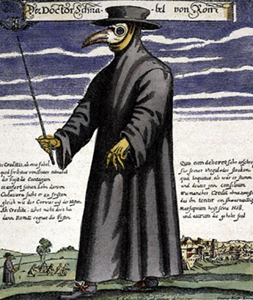
I wonder if the man's doctor had to wear protective gear, like this:
 

Wednesday, August 10, 2011

File Under "Things I Wish I'd Known in Grad School"

Teh internets have spoken. A blog post over at TinyCatPants alerted me to the possibility that part of the early medieval period, specifically 614-911, never happened. Apparently, the whole ball of wax--Charlemagne, King Alfred the Great, the sack of Lindisfarne--was cooked up by Otto III and Gerbert of Aurillac (Pope Sylvester II).

Now, Gerbert was believed to have some pretty special powers, like being able to summon demons, foretell the future, and discover buried treasure, and he was also thought to have a swanky brazen head that whispered secrets to him, but inventing an entire three centuries? Hmm... On the other hand, I recently learned, in the course of a sustained research project, that Gerbert--diabolical communion aside--was a straight-A student in mathematics and astronomy. He probably had the chops to forge the calendar.

My question is: Why 614-911 specifically? It covers the lifetimes of Gerbert and Otto (and Otto's father and grandfather) and allowed Otto, as Holy Roman Emperor, to invent a fabulously powerful imperial predecessor. Isidore of Seville loses the last few decades of his lifetime (bummer) and Bede and Alcuin never existed at all?

But although this conspiracy theory is fantastically far-fetched, it does echo some of the wilder legends from the Middle Ages (see above: Gerbert). And forgeries--of documents and holy relics--were rampant. So maybe it all kind of fits together...

Friday, March 25, 2011

Friday YouTube Gems: The Vikings/Depeche Mode

Historical events have intervened, making it difficult to keep up the blog posts for the past few weeks. But here's another goody from the folks over at historyteachers:


Vikings are totally badass.

Friday, March 11, 2011

Friday YouTube Gems: The Crusades/Billy Idol

This just in from one of our far-flung correspondents.


I was originally slated to teach a course on the Crusades next autumn, but I will instead be teaching a freshman seminar on the history of the liberal arts and medieval intellectual culture. This fabulous video (which references primogeniture and "Deus lo veult!") really, really makes me sad that I'm not teaching the Crusades next year.