Showing posts with label wtf. Show all posts

Tuesday, July 11, 2017

Further Adventures in Medievalism: Squatty Potty Edition

I've explored the reason why it matters that we so often equate the medieval past with squalor and filth. So I was delighted when a friend sent me a link to the ad for Squatty Potty (tm) and its adjunct product, Unicorn Gold (tm).


The fancy clothes and posh accents of the spokesman and the courtly ladies put a little polish on the fact that we're watching an ad about shitting and farting. And the clothes themselves are a mix of ancien regime wigs and panniers for the ladies and mock-Tudor doublet and slashed sleeves for the spokesman, signifying a generalized "pre-modern" period ("Humans have been pooping for over a hundred years"). Even the child in the Unicorn Gold (tm) ad reflects the tendency in European portraiture in the 17th-19th centuries to depict children clothed like small adults. During the late Gothic period, the unicorn often signified rarity, beauty, and purity. The use of "real freaking gold" recalls the importance of potable gold as a panacea in medieval and early modern medicine (for those who could afford it), and the admonition to use Unicorn Gold (tm) "when you pay your taxes to King John" is a neat pun as well as an allusion to the plot of virtually every Robin Hood storyline in the 20th and 21st centuries. 

Using medievalism to advertise products related to poop aligns with existing ideas about the grossness of "the Middle Ages." Yet, in a neat inversion of this existing association, the past portrayed in these ads is also more desirable than the present. Hemorrhoids are brought on by the design flaws in modern plumbing; the toilet does not accommodate the human body. And it can be said of the people of Ye Olden Days (at least for the ones who use Unicorn Gold (tm)) that their shit don't stink. Medieval is the new modern.

Wednesday, November 9, 2016

The Mirror of History

"Medieval is the new modern" is the tagline of this blog. I came up with it five years ago as a shorthand to signify both that many of the hallmarks of "modernity" have a long history stretching back to the medieval period, and to highlight the persistent medievalism in contemporary culture. 

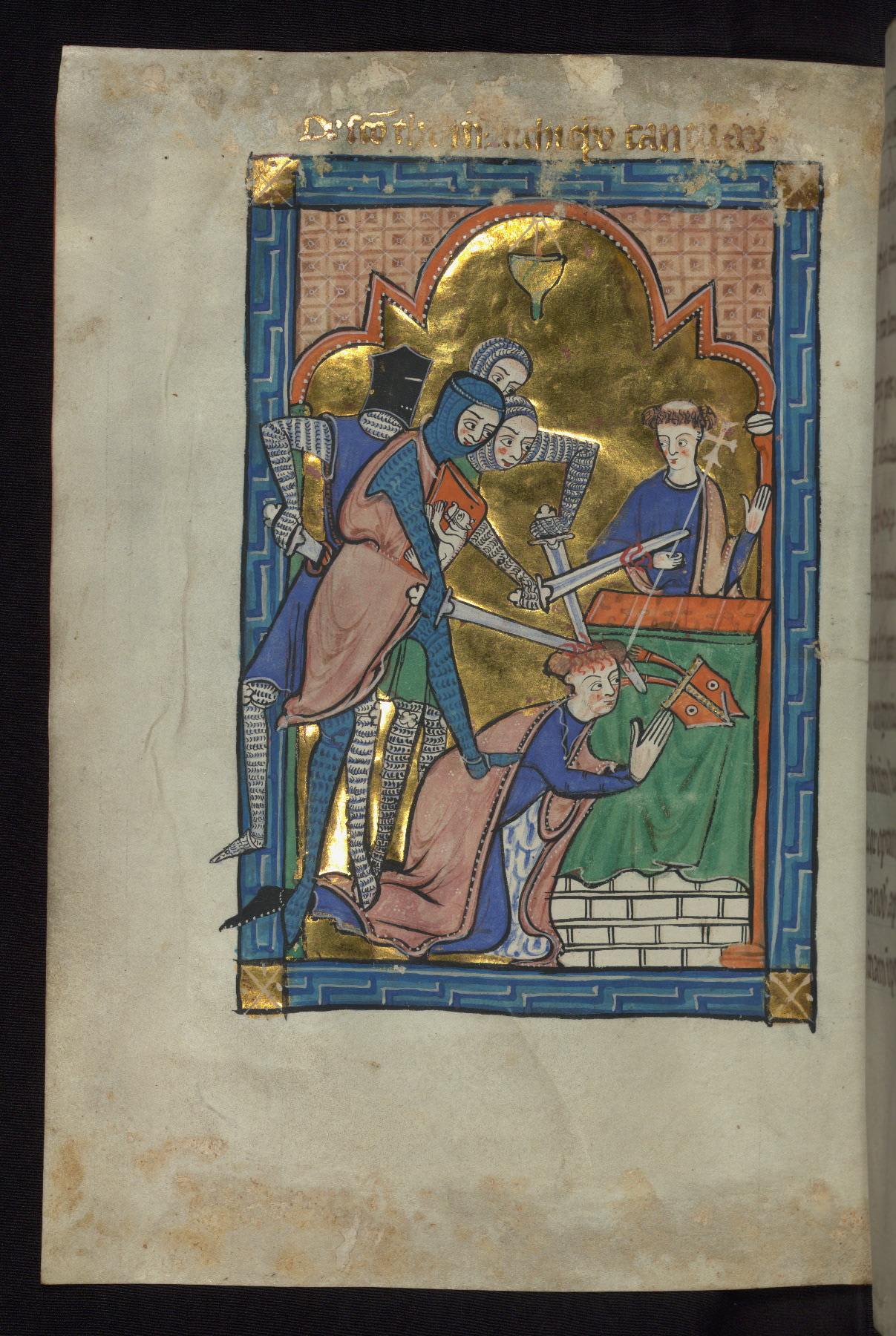
Walters MS W. 34, fol. 15v.
Of course, "modernity"--just like "the West"--is an ideological construct, and it relies on "medieval" as the pre- or anti-modern category that defines its opposite. "Medieval" is the term that describes the primitive, ignorant, barbaric era that preceded the "Renaissance," the period of rebirth that banished slavish devotion to authority with inquiry and pursuit of intellectual novelty. This established, comforting narrative goes all the way back to (where else?) the medieval period, with Petrarch's lament that he lived in a "dark age." The medieval period undergirds the the narrative of progress; the period is the naive, uncivilized era that "the West" escaped or matured out of with the Renaissance (the individual), the Scientific Revolution (rationality over religion), the Enlightenment (liberalism and secularism), and the Industrial Revolution (wealth of some nations). The medieval period--a vast span of time over the globe replaced by a false, unitary time and place--reminds the philosophers, politicians, and scholars of "the West" of how far we've all come, and becomes a shorthand for what separates us from people living in other places, rather than those living in another time.

But in light of recent events, the Middle Ages are more important than ever. They offer an example of what cataclysmic demographic, political, religious, cultural, and economic change look like. Both halves of the Roman Empire provide object lessons in the perils posed to stability when the ruling elite becomes corrupt and sclerotic, and when abrupt demographic change occurs. By studying the medieval period we can see what happens--on a large scale--during a period of sustained climate change. The Middle Ages offer a mirror of what it looks like to live outside of the paradigm of progress. Medieval is the new modern.

Friday, December 13, 2013

The Year in Robots

I've been doing some sifting through the year's news stories about robotics and robots to do a round-up post. But then I came across Lewis Black's segment on last night's Daily Show and thought, why bother?

Thursday, June 13, 2013

A Visit to Schloss Hellbrunn

I recently had the good fortune to visit Schloss Hellbrunn, outside Salzburg. The palace has one of the oldest and most extensive collections of automata and trick fountains still in evidence (and still working). It was completely enchanting and also very illuminating.

Schloss Hellbrunn was built in the early 17th century, at the command of Archbishop Markus Sittikus. It was intended to be a "summer palace"--a place for the great and good of Salzburg to spend a summer afternoon, before returning to their homes in the city. The archbishop's guests would dine al fresco in the Roman Theater, surrounded by fountains and statues. The basin in the middle of the table keeps the wine chilled. And the table and seats have hidden water jets that would soak the guests (but not the archbishop). Remember, court etiquette dictates that one cannot rise from the table unless the highest-ranking person does so first. So the archbishop would stay dry and seated, while his guests had to master their surprise and discomfort...and remain seated, no matter what.
The Royal Table in the Roman Theater.
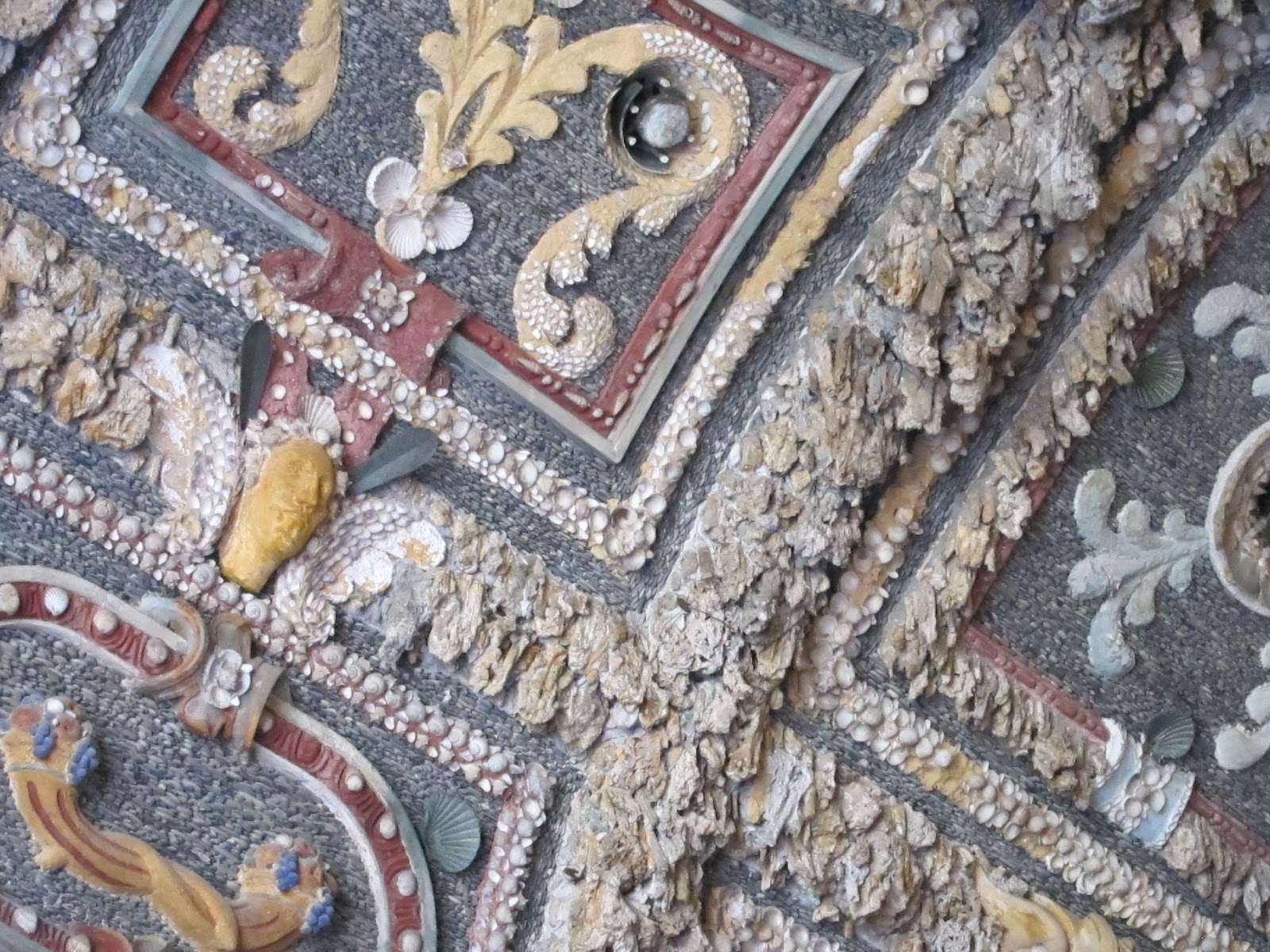
Guests could (and can) stroll into the palace grottoes, beginning with the Neptune Grotto. A statue of Neptune dominates the space, and the walls and ceiling are covered in a sort of marine mosaic, with tiny shells forming the tesserae.

A close up of the decoration in the Neptune Grotto.
At the foot of the Neptune statue, the Germaul rolls his eyes and sticks out his tongue at the visitors. This was Archbishop Sittikus' response to his critics.


Upon leaving the Neptune Grotto and the charming Germaul, you have the chance to get sprayed with water...again. And, after escaping from the grotto and standing safely outside...this happens:
Don't look up!

In fact, one of the most interesting aspects of the Wasserspiele is how they force spectators into different spaces, in the hope of escaping the water, and, of course, it just ends up being yet another opportunity for a shower. The sense of not knowing what is coming next definitely keeps people (including me) off-balance. Some of the fountains are simply lovely, like these turtles, and pose no threat to the enchanted onlooker.


Delight, amazement, uncertainty, and suspicion mingle with one another; these emotions are punctuated by bursts of Schadenfreude when an unsuspecting person gets thoroughly soaked. (For example, during my tour, the brave souls who sat at the Royal Table spent the next hour looking like they'd wet their pants.)

Along the way are small tableaux quasi-vivants, illustrating scenes of artisanal labor and Classical myth. (Blogger won't let me upload the video, so this still shot will have to do.)
This is a scene of a couple grinding scissors.
 After many other stops along the way, the final attraction is the Crown Grotto (completed after Sittikus' death in 1618). The golden crown shoots up to the ceiling, driven by a jet of water. Eventually, it comes back down, representing (I think) the rise and fall of earthly power. 
The crown falls back down. The spectators are amazed!


All of the Wasserspiele are hydraulic-powered. While much of the plumbing is now PVC (there are still some copper and lead pipes), the original pipes were made of wood.
This might be the most amazing aspect of my entire visit.


Saturday, April 6, 2013

The Dystopic Future of Education Is Here

What an eye-opening week for higher education! Thanks to the folks at EdX, computers will soon be grading college papers. 

"The system then uses a variety of machine-learning techniques to train itself to be able to grade any number of essays or answers automatically and almost instantaneously.
The software will assign a grade depending on the scoring system created by the teacher, whether it is a letter grade or numerical rank. It will also provide general feedback, like telling a student whether an answer was on topic or not." 
It's true that I'm somewhat tempted by this; I'm looking at a very large stack of papers to grade this weekend. But this sounds like a bad idea for two reasons: The first is that offering feedback about whether  a paper is "on topic or not" is not particularly helpful for a student who needs to learn critical thinking skills. Mastering a particular topic or some information is far less important than mastery of logic and rhetoric; additionally, the latter are ultimately transferable from one kind of task to another, unlike the former. The second reason is that I don't think the increased automation of education is a good idea. Or, put a different way, I don't think it's a good idea for learning anything other than basic content.
Not only is human-graded student work going out the window, but those entire pesky universities are, too. EdX is also teaming up with Pearson, the educational testing service, to offer proctored exams for certificate credit to MOOC enrollees. Yes, the for-profit education testing service is now going to be in the business of accrediting MOOCs for students who want to get academic credit. And the Minerva Project offers the promise of a "hybrid" model--MOOCs and a residential college experience. Pay for both experiences, but without getting as much as either has to offer by itself. The privatization of college education is here to stay.

Saturday, March 9, 2013

The Quick and the Dead

Reports that the body of recently deceased Venezuelan president, Hugo Chavez, will be embalmed and placed on "permanent" display at the Museum of the Revolution have brought to mind other examples of this phenomenon. Other revered Communist leaders, such as Lenin, Mao Zedong, and Ho Chi Minh, received the same treatment after their deaths. And, of course, there are many examples of Christian saints whose bodies remain on display (or are brought out periodically). 

Placing the bodies of particularly revered or heroic figures on display has a long history. In medieval historical writing (including historical chronicle and epic poems), heroic warriors from Troy and Carthage were embalmed (sometimes with magical fluids) and preserved for eternity. Hector, the prince of Troy, was placed in the open, where his subjects could see him. In one account, the embalming fluid went in at the top of his skull, and then flowed through his veins into his extremities. 
Hector's embalmed body.
Cod. Bodmer 78, fol, 58r
-->


According to many natural philosophers, a person could not be considered fully dead until decay or putrefaction occurred. So keeping Hector perfectly "fresh" actually meant keeping him partially alive. Kind of like Han Solo in carbonite, or Wesley in "The Princess Bride."

Friday, February 15, 2013

Russian Meteorite Could Provide the Next Excalibur

Intense! That Russian meteor was bananas. Apparently, the bright explosion was perhaps caused by the amount of iron in it. 
 
This meteor was unusual because its material was so hard — it may have been made of iron, the statement said — which allowed some small fragments, or meteorites, perhaps 5 percent of the meteor’s mass, to reach the Earth’s surface.

An enterprising smith could, under the right influences, forge this meteoric iron into a sword for the ages. 


Fallen to earth in a falling star, a clap of thunder, a great burst of light; dragged still smoking to be forged by the little dark smiths who dwelled on the chalk before the ring stones were raised; powerful, a weapon for a king, broken and reforged this time into the long leaf-shaped blade, tooled and annealed in blood and fire, hardened...a sword three times forged, never ripped out of the earth’s womb, and thus twice holy.... (Marion Zimmer Bradley, The Mists of Avalon)

Except that apparently Terry Pratchett has already done this.

Saturday, January 12, 2013

And Speaking of Exploitative & Oppressive Structures...

The IRS has just put colleges and universities on notice not to under-estimate the number of hours that adjunct faculty work. Many schools only count the number of hours in the classroom, as opposed to counting time spent preparing or grading (these, combined, far exceed the number of hours spent in the classroom; for every 70-minute lecture that I give, I spend between 8-14 hours writing it). But, thanks to Obamacare, working more than 30 hours a week for an employer makes one eligible for health insurance. 

This is so great, right?! The federal government totally gets that many college professors in this country are adjunct or part-time and that, as such, they earn minimal ducats and often have no benefits of any kind. 

Sadly, no. Some schools are already taking steps to cut adjunct faculty hours so that they will not have to shoulder the burden of providing health insurance for their employees. Which begs the question: Doesn't it seem like university professors and administrators would recognize that it is in their best interests (economic, institution-building, quality of teaching, flexibility) to support single-payer health insurance?

Friday, November 9, 2012

Tuesday, October 9, 2012

Natura artifex Redux

Here are three images of Natura artifex, or Natura the artisan, standing at her forge. She uses a hammer and anvil to create new people out of existing archetypes.

You've seen this one before. Natura is forging new people out of parts.
Yale University, MS 418, fol. 282v. France, C15.
 AW, our DC correspondent, alerted me to this version, from a slightly later manuscript. Instead of limbs, she has a baby on the anvil, and dismembered baby bodies lie at her feet.
BL, MS Harley 4425, fol. 140. Flemish (Bruges), late C15.
 And then there's this one. A naked Natura stands at her forge, whanging away at a wang and Balzac.
Obscene pewter badge of Nature at her forge. Netherlands, late C15.Heilig en Profaan: Laatmiddeleeuwse Insignes in Cultuurhistorisch Perspectief. Amsterdam: Van Soeren, 1995.

Saturday, September 8, 2012

Black Death PSA: It's Still A Good Idea to Stay Away from Vermin

...especially when it's already dead. 

A young girl in Colorado contracted the Black Death after trying to give an infected squirrel carcass a proper burial. The flea bites on the girl tipped off the doctors trying to diagnose her. 

Wednesday, August 8, 2012

Olympic Robots

Just back after ten days in various secluded locations, none of which had any kind of wi-fi. Bliss. I did have access to the gross NBC broadcast of the Olympics, which I dutifully watched, while gnashing my teeth in rage at the inanity of the commentators. (The "bigger" the sport, the worse the commentators, I think.)

But the highlight of my Olympics so far has been the robotic red double decker bus that can do far more push-ups than I can.

Friday, June 15, 2012

Black Death PSA: Stay Away from Vermin

An Oregon man has been hospitalized in Bend with a disease that appears to be caused by Y. pestis, aka the Black Death. He got it after trying to rescue a mouse from the mouth of a stray cat. People, just stay away from the things cats put in their mouths. Also, beware of mice, rats, and other rodents, including squirrels (esp. in northern CA, which has seen a rash of squirrel deaths caused by the plague). They carry fleas that can transmit the disease.

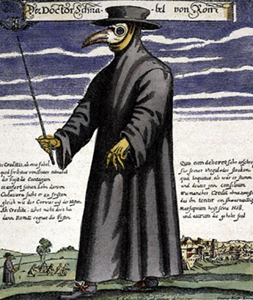
I wonder if the man's doctor had to wear protective gear, like this: