Showing posts with label robots. Show all posts

Saturday, May 20, 2017

The Long History of A.I.

"Time is, time was, time is past," quoth the Brazen Head.
I recently had occasion to discuss medieval legends of oracular heads (brazen and other) in the context of the history of artificial intelligence. Gerbert of Aurillac (Pope Sylvester II), according to William of Malmesbury, made an oracular head using astral science that would answer questions "yes" or "no." Gerbert asked the head a question about the circumstances of his death, but misinterpreted the head's answer, and so died anyway. It's possible that William's proximity to Wales accounts for his tale of the oracular head; previous versions of this legend suggested that Gerbert had summoned a demon, using necromancy, to question about his death, and, according to Celtic legends, the decapitated heads of one's vanquished enemy could be used as oracles.

A few centuries later, John Gower transposed elements of this story to Robert Grosseteste, the Franciscan scholar and Bishop of Lincoln. In Gower's version, Grosseteste used astral science to make a brazen head that would foretell the future; unfortunately, Grosseteste slept through the head's pronouncements. At roughly the same time (late fourteenth century), Albert the Great, Dominican scholar and Bishop of Cologne, was credited with having used astral science to make a prophetic statue. In this version, found in a text on Christian morality (Albert exemplifies wisdom), one of Albert's brethren happens upon the statue and destroys it out of fear and ignorance. And just over two hundred years later, Roger Bacon, Franciscan scholar, was immortalized in an Elizabethan play as the "conjuring friar" who used necromancy to summon a demon who forged him a brass head, and which Bacon then animated via celestial magic. Like Grosseteste, his fellow Franciscan--and his intellectual forebear--Bacon, exhausted from his unceasing labors, slept through the head's pronouncement. 

A few common strands emerge from these different stories. In all instances, the man responsible for the head was known--in his lifetime, as well as after--for surpassing wisdom and skill in astral science, and interest in scientific instruments. Furthermore, in all instances, the purpose of the head is either prophecy or a more nebulous "secrets of nature." Additionally, the knowledge that the head provides is "out there"--that the future is already written, that the secrets of nature are not secret to all, but not vouchsafed to human intellect. Finally, and this may be the most salient point, the artificial intelligence is successfully created--the head tells its secrets, but humans are too weak or foolish to understand: we display confirmation bias and cannot correctly interpret what the head tells us (Gerbert), we have weak bodies and need sleep (Grosseteste, Bacon), or others prevent us from realizing our goals due to their own ignorance and fear. 

Thursday, October 27, 2016

Robots: Will Either Kill Us or Help Us to Death

Greetings, humans. Lots of medieval/robot news to share.

While the NYT reports that the Pentagon is confronting the reality of autonomous killing devices, a new center dedicated to ethical, computational, engineering, and social dimensions of human and machine intelligence just launched at Cambridge University. Meanwhile, San Jose airport has just installed new employees--robot "greeters" to help bewildered passengers. But why do they look female? Laurie Penny explains it all. Finally, fans of the original "Westworld" who had hoped that the new tv show would include Medieval World can continue to keep hope alive...

Wednesday, September 30, 2015

Creating Lives in "Black Mirror" and "Ex Machina"

Netflix has just announced that it will produce another dozen episodes of "Black Mirror," hallelujah. The brilliant series interrogates later-capitalist techno-modernity and the shifting boundaries between self and object--specifically, our personal computing devices. This broad topic--humanity's relationship to intelligent computers and robots--has been explored recently in the new tv show "Humans" on AMC and Alex Garland's Biblically inspired film, "Ex Machina." But "Black Mirror" tackles gender in ways that complicate and enrich the narratives of human-machine relations, and that are not replicated elsewhere.

Daniel Mendelsohn, in a superb essay out this summer in the NYRB, explored "Ex Machina," Spike Jonze's "Her," and the lineage of sentient machines in the western cultural imagination, arguing that the current crop of films and tv shows are less about machines that become like humans, and more about humans that become like soulless automatons. Mendelsohn used examples to describe both what he calls the "economic" kind of robots--machines that replace or augment human labor--and the "theological"--sentient objects made in their makers' images. Both groups of objects include those gendered as male (Talus, Frankenstein) and female (Haephestus' handmaidens, Ava). 

Many tales of the sentient machine have an erotic charge. Ava, the SAI droid in "Ex Machina," was made, like her "sisters," to fulfill her creator's sexual fantasies. Of course, this goes all the way back to Pygmalion's statue of Galatea, whom Pygmalion created, adored, and used sexually before she was "brought to life" by Aphrodite. In fact, in every example that I can think of, when this story--of the creator and his uncannily life-like creation--appears with erotic elements, the creator is male and the created object is female. 

Like "Ex Machina," "Be Right Back," the first episode of the second series of "Black Mirror" also takes up the limits of the human creator and the human-machine relationship. But unlike the other examples, the machine-being in "Be Right Back" is male, and the creator who calls him into being is female. Martha (Hayley Atwell) and Ash (Domhnall Gleeson)* move to a new house; Ash, addicted to his smart phone and social media updates, dies in a car accident; Martha discovers she's pregnant. She pays a service that mines Ash's entire online presence to create a simulacrum of him, first as a disembodied AI program, and then fully embodied in a synthetic form that is almost identical to Ash. As Martha, pregnant with Ash's child (we see them having pretty banal, and--to Martha--unsatisfying sex earlier), prepares to create a new life, she practices by bringing an old life (Ash) back. The synthetic version of Ash is eerily servile and literal-minded, but he is also an improvement on the "real" Ash in some ways. For example, he is a much more satisfying and skilled lover, something that delights and also discomfits Martha. 

By making the creator figure a woman and the object a man, Charlie Brooker, the writer, highlights the importance of gender in creation stories in a way that is ultimately far more interesting than Garland's patriarchal "Ex Machina." Martha "creates" Ash just after she discovers that she is pregnant, and key moments of bonding with the synthetic Ash occur alongside hallmarks of her pregnancy, like when she shares the first sonogram image with the disembodied AI Ash. Brooker juxtaposes the narrative of natural creation (pregnancy, baby) with artificial creation (synthetic human replacement) and asks, how are we responsible for what we create? Martha grows to regret her synthetic creation, but she cannot destroy or abandon it. Part of the reason why is hinted in the poignant coda, which shows that the synthetic Ash is still "alive," but banished to the attic, where he is visited once a year by Martha's other creation, her daughter. This "father" is the only father her daughter will know. 

*Of course, Domhnall Gleeson is the sacrificial Caleb in "Ex Machina."

Saturday, September 26, 2015

Animals & Machines

St. Thomas Aquinas, in Summa contra Gentiles, compared animals to machines--lacking reason, animals behave in a prescribed sequence of actions, much like how a crossbow bolt is propelled forward by the force of the bow. What, I wonder, would he make of these animals, from various species, that attack drones? 

I suppose he might take it as further evidence for the similarity between animals and machines. But then there are the cats who have figured out how to use Roombas as mobile cat beds. Crows aren't the only animals who've figure out how to use tools...

Monday, January 27, 2014

Do People Even Like Robots?

It's nice to be able to invite a guest to your wedding and know that he or she isn't going to make a terrible speech or throw up on the wedding cake. On the other hand, it's also nice to be able to invite a guest to your wedding and know that he or she isn't going to make the other guests feel awkward and uncomfortable, merely by showing up. 

This is the dilemma posed by robot wedding guests, and I learned about this thanks to the recent article in the "Vows" section of the New York Times. Ideally, the robots act as telepresence proxies for guests who can't attend, but still want to be a part of the festivities (although at least one enterprising couple had a robot officiate the ceremony). Of course, the downside is that people still aren't that comfortable interacting with robots, so once the novelty wears off they are largely ignored. 

As men pulled their dates to the dance floor in Australia, Mr. O’Neill watched from Canada sitting at his computer dressed in a suit with a beer in hand, and was able to see what was happening only right in front of the seat where his brothers had propped up the robot.
“I was unconsciously turning my head to talk to people and realizing I’m in a cold, dark basement and it’s 1 in the morning,” he said.

This reminded me of the first episode of season 5 of The Good Wife. I think the callous behavior that the LG employees show toward "Monica" (a co-worker who interfaces with the firm via telepresence robot) emphasizes both the way that certain technologies destabilize social norms and disrupt communication (even--or perhaps especially--if that technology is supposed to enhance communication) and the generally toxic environment at LG.

Compare these examples, in which the human-robot interactions never become truly functional or integrated, with "Robot & Frank," in which the robot and protagonist forge a bond that is as emotionally complex as the one that Frank has with his children. It may be that "The Good Wife" is simply a more accurate reflection of how people feel about robots right now, and "Robot & Frank" is speculative fiction about a near-future in which robots are a little more responsive, a little more common.

More interesting still is that the telepresence robot in "The Good Wife" and some of the examples in the NYT article strongly resemble the descriptions of the wheeled tripodal servants that Haphaestus forged to serve the gods on Mt. Olympus. Indeed, perhaps our longstanding association between "robots" and "servants/slaves" is what makes us react to robotic avatars with discomfort, since they violate that association.

Friday, December 13, 2013

The Year in Robots

I've been doing some sifting through the year's news stories about robotics and robots to do a round-up post. But then I came across Lewis Black's segment on last night's Daily Show and thought, why bother?

Friday, November 8, 2013

Robots from Days Gone By

Amazing automata from ye olden times have been cropping up everywhere recently! The New York Times recently ran an article about the creations of R. J. Wensley, a robotics engineer and inventor from the first half of the 20th century.* And then the folks at Colossal got excited about Simon Schaeffer's recent (and fabulous) BBC documentary, and a few of the 18th century automata that he profiles. One of these, L'écrivain, is from the workshop of Pierre & Henri-Louis Jaquet-Droz. Adelheid Voskuhl has a recent piece in Slate about the importance of the Jaquet-Droz and other Enlightenment
automata.Voskuhl's argument, based on her recent (and fabulous) book Androids in the Enlightenment, is that these luxury objects actually modeled new forms of civic engagement and social behavior by performing affective practices that were important to bourgeois and aristocratic Enlightenment culture. These automata, especially the piano-playing women that Voskuhl focuses on in her book, are conceptually similar to the 16th century praying monk, commissioned by King Charles V of Spain, that demonstrated  proper devotional practice, and to the imaginary figures from the Alabaster Chamber in the 12th-century Roman de Troie, which enacted and enforced courtly behavior.


* While I'm always happy to see Leonardo get name-checked, esp. in relation to early automata, it goes without saying that the *entire point of this blog* is to make it clear that these objects were imagined and built well before the fifteenth century.

Wednesday, October 16, 2013

Aaaaaand, We're Back!

Sorry for the radio silence. I've been finishing the book of medieval robots. Still a long road ahead, but I'm closer than before. Watch this space for more details as they emerge!

Thursday, June 13, 2013

A Visit to Schloss Hellbrunn

I recently had the good fortune to visit Schloss Hellbrunn, outside Salzburg. The palace has one of the oldest and most extensive collections of automata and trick fountains still in evidence (and still working). It was completely enchanting and also very illuminating.

Schloss Hellbrunn was built in the early 17th century, at the command of Archbishop Markus Sittikus. It was intended to be a "summer palace"--a place for the great and good of Salzburg to spend a summer afternoon, before returning to their homes in the city. The archbishop's guests would dine al fresco in the Roman Theater, surrounded by fountains and statues. The basin in the middle of the table keeps the wine chilled. And the table and seats have hidden water jets that would soak the guests (but not the archbishop). Remember, court etiquette dictates that one cannot rise from the table unless the highest-ranking person does so first. So the archbishop would stay dry and seated, while his guests had to master their surprise and discomfort...and remain seated, no matter what.
The Royal Table in the Roman Theater.
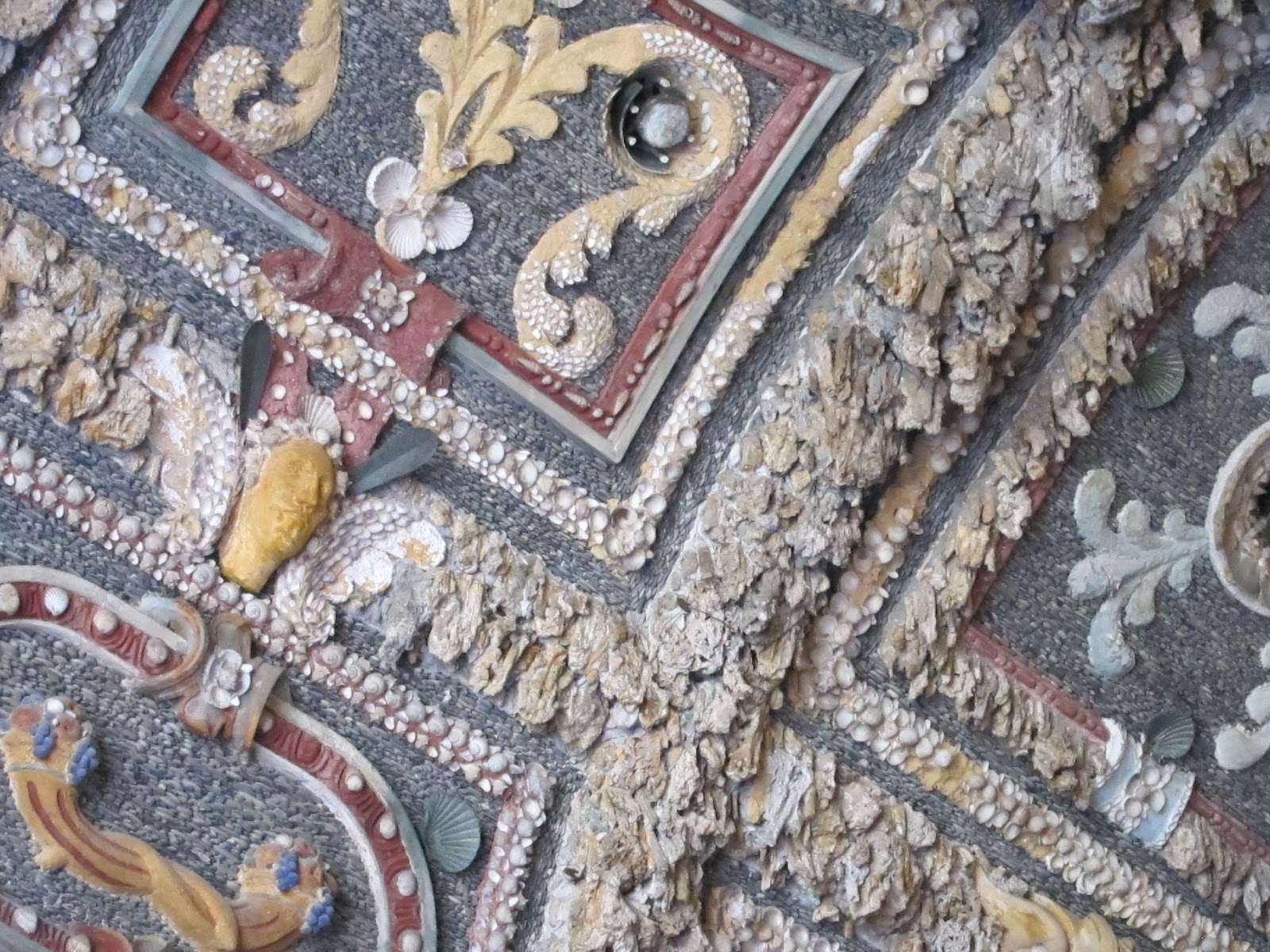
Guests could (and can) stroll into the palace grottoes, beginning with the Neptune Grotto. A statue of Neptune dominates the space, and the walls and ceiling are covered in a sort of marine mosaic, with tiny shells forming the tesserae.

A close up of the decoration in the Neptune Grotto.
At the foot of the Neptune statue, the Germaul rolls his eyes and sticks out his tongue at the visitors. This was Archbishop Sittikus' response to his critics.


Upon leaving the Neptune Grotto and the charming Germaul, you have the chance to get sprayed with water...again. And, after escaping from the grotto and standing safely outside...this happens:
Don't look up!

In fact, one of the most interesting aspects of the Wasserspiele is how they force spectators into different spaces, in the hope of escaping the water, and, of course, it just ends up being yet another opportunity for a shower. The sense of not knowing what is coming next definitely keeps people (including me) off-balance. Some of the fountains are simply lovely, like these turtles, and pose no threat to the enchanted onlooker.


Delight, amazement, uncertainty, and suspicion mingle with one another; these emotions are punctuated by bursts of Schadenfreude when an unsuspecting person gets thoroughly soaked. (For example, during my tour, the brave souls who sat at the Royal Table spent the next hour looking like they'd wet their pants.)

Along the way are small tableaux quasi-vivants, illustrating scenes of artisanal labor and Classical myth. (Blogger won't let me upload the video, so this still shot will have to do.)
This is a scene of a couple grinding scissors.
 After many other stops along the way, the final attraction is the Crown Grotto (completed after Sittikus' death in 1618). The golden crown shoots up to the ceiling, driven by a jet of water. Eventually, it comes back down, representing (I think) the rise and fall of earthly power. 
The crown falls back down. The spectators are amazed!


All of the Wasserspiele are hydraulic-powered. While much of the plumbing is now PVC (there are still some copper and lead pipes), the original pipes were made of wood.
This might be the most amazing aspect of my entire visit.


Tuesday, June 4, 2013

Check Out BBC Doc "Mechanical Marvels: Clockwork Dreams"

BBC Four just aired a cracking documentary on automata, written and presented by historian of science Simon Schaffer. It's really good, and you should watch it. It covers early clockwork machinery, jacquemarts (bell-ringers) and clockwork automata, minaturization, revolution, fraud, and the replacement of human workers with machines. I particularly liked the section on Schloss Hellbrunn (which I shall be visiting later this summer) and the way that the "Mechanical Theatre" depicts the nobility's idea of a utopian society, complete with perfectly regular laborers. Schaeffer makes some interesting connections to the fact that horological and artistic innovation rested mainly on low-paid, low-status artisanal workers; these artisanal workers ended up displacing themselves when captains of industry built machines, using the same principles as elaborate, richly decorated luxury automata, to replace human labor. 

Schaffer's expertise as a scholar is in early modern science, and he concentrates in the documentary on the automata of the seventeenth and eighteenth centuries. I have a few small emendations to offer to Schaffer's narrative. Although it's true that the regularity of clockwork machinery became used as a metaphor to understand the human body in the early modern period, early modern automata were not the first to mimic natural forms. The ancient Greeks, especially in the Alexandrian School (3rd-1st centuries BCE) designed fabulous automata (driven by pneumatics and hydraulics, rather than the verge-and-foliot escapement and falling weight drive of the early modern period) in the forms of animals and people. And Arabic engineers, in the ninth and thirteenth centuries, wrote detailed treatises on how to build programmable, musical fountains; mechanical servants; and elaborate clocks. It's also interesting to note that in the Middle Ages, descriptions of automata in narrative texts often describe them as perfect servants and as enforcers of different kinds of behavior. 

Still, the documentary is a treat, and if you're interested in automata, horology, or the history of technology, you should see it.


Sunday, April 21, 2013

Not Content

Recent articles and incisive blog posts about MOOCs, alongside few more recent news articles that present different ideas about the purpose of higher education in this country have vividly illustrated the shift to thinking about education as content and students as users. I don't have a lot to add to Historiann's fantastic close reading of the decision of Amherst faculty to turn down the opportunity to partner with EdX; however, it's notable that this story hit Inside Higher Ed just a few days before A. J. Jacobs review of MOOCs and Frank Bruni's column on the purpose of higher education both appeared in the NYT.

Bruni writes about the debates at the UT flagship campus in Austin: Is college intended to provide job training, or something else? This is an open question, as lawmakers and educators in Texas, Virginia, Oregon, and many other states are increasingly interested in providing job placement statistics and salary figures for graduates with different majors. But, as some high-profile educators have pointed out, judging the worthiness of a college education by immediate post-college graduate earnings is far too narrow a metric. A liberal arts education does more than train someone for a job; it gives young people the skills to envision and invent the jobs they want, and it helps them become better global citizens and community members. But this view can certainly seem like a luxury, given the high numbers of unemployment for people under 25 and ballooning student debt.

I don't think anyone working in higher education today is unaware--at least to some degree--of the many stresses on both private and public higher ed in this country, and the difficult choices they are going to force.* And I certainly think instructional technology can provide pedagogically exciting opportunities to meet some of these challenges and to democratize education. The Jacobs piece, however, exposes some of the major issues that MOOCs present: attrition, isolation, and the idea that education is the same as content-delivery. If that's the case, then why not just do away with MOOCs entirely, and just skip to Wikipedia and YouTube? This is a slight exaggeration, but I do think that, at its core, this idea of education seems to be based around a "content-provider" platform. Professors provide the content, which EdX, Udacity, etc. then provide to the user. Content is static, not dynamic (the lectures, once written, recorded, and produced once, can be essentially "syndicated" and repeated every year or two). The other tacit assumption that this model rests on is that teaching and learning are scalable. This, it seems to me, is what the Amherst faculty found most at odds with their mission to provide education "through close colloquy." The scalability of education that MOOCs promise is also part of the "content-provider" model: I can watch content on my tv, my computer, my tablet, and my phone, anywhere I go (Jacobs addresses this explicitly). Education through "close colloquy" between students and faculty isn't scalable, and it's not portable. How long before we see EdX or Coursera partnering with Comcast or Time-Warner? Has that already happened?
 
*Indeed, I recently talked to someone who'd been at a large meeting with the president of an extremely wealthy, extremely prestigious private university. When asked by an attendee what the president was optimistic or excited about w/r/t the future of higher education, the president chuckled bleakly.

Tuesday, February 19, 2013

Playing Those Medieval Robot Games

Google has alerted me to the fact that Starbound, a PC game that should be coming out in the next few months, contains medieval robots. The Glitch, a collective simulation of artificial, sentient, self-aware beings, were created by a god-like race to simulate the process of "civilization." But all of the experiments destroyed themselves, except for the ones that are still stuck in the Middle Ages. 

I need your help here, folks. I know nothing about gaming, but this sounds awesome. If you have any information about Starbound or its world, let me know! 

Tuesday, December 11, 2012

Robots Are Taking Our Jobs, Says Krugman. Next They'll be NYT Columnists!

According to Paul Krugman, the nineteenth century is the new black. Robber barons, David Ricardo, Das Kapital--it's all very now. Except then all the robots are going to steal our jobs. 
 "...there’s no question that in some high-profile industries, technology is displacing workers of all, or almost all, kinds. For example, one of the reasons some high-technology manufacturing has lately been moving back to the United States is that these days the most valuable piece of a computer, the motherboard, is basically made by robots, so cheap Asian labor is no longer a reason to produce them abroad." 
But the robots won't be satisfied with only manufacturing jobs! They want to perform highly-skilled labor.
"[snip] Many of the jobs being displaced are high-skill and high-wage; the downside of technology isn’t limited to menial workers."
Technology is putting labor at a disadvantage, and growing monopoly power enriches plutocrats. The result is an increasingly classist, two-tiered society.
And suddenly we live in a horrible dystopia predicted in the classic Weimar sci-fi expressionist film!

Friday, October 19, 2012

Medieval Star Wars!

This is the perfect mashup of "medieval" and "robots."


  • I feel like the talented Chawakarn Kongprasert has illuminated my psyche.

Wednesday, August 8, 2012

Olympic Robots

Just back after ten days in various secluded locations, none of which had any kind of wi-fi. Bliss. I did have access to the gross NBC broadcast of the Olympics, which I dutifully watched, while gnashing my teeth in rage at the inanity of the commentators. (The "bigger" the sport, the worse the commentators, I think.)

But the highlight of my Olympics so far has been the robotic red double decker bus that can do far more push-ups than I can.

Wednesday, July 18, 2012

The Sims

Hey folks. Medieval Robots is back from summer hiatus. After finishing a draft of The Big Book of Medieval Robots, I needed some time off to replenish my word-hoard.

Serendipitously, CT over at Brand Avenue tipped me off to the exciting world of patient simulators. Rather than actors appearing in a Beckett play (my first thought), patient simulators are physiologically accurate human robots, like SimMan2(tm). These proxy patients squirt, spurt, secrete, excrete, expel, discharge, and produce a range of fluids and solids (including a baby and placenta), and display subtle symptoms (changes in pupil dilation, respiration, temperature, etc.) that correspond to a variety of medical situations. They're increasingly used in training physicians and nurses

One can only hope that they will appear in a horror film before too long. I can see it: a group of residents gets locked in the skills lab overnight, just as the hospital is evacuated for some compelling reason. The simulators attack the residents, subjecting them in turn to the same torture they have inflicted. The residents must use their skills to save one another, but realize that their time spent in the artificial environment of the lab has made them ill-equipped to treat actual people. Obviously, all except for two of the residents die, the sims are destroyed, and the surviving doctors swear to practice only on human patients.

But doctors have practiced on patients that they deemed less than fully human for some time. J. Marion Sims, widely regarded as the father of modern gynaecology, perfected a surgical repair for vesicovaginal fistula by operating repeatedly, and without anaesthesia, on a trio of slave women. Once he had perfected his technique, he used anaesthesia on his Caucasian patients.*

*Sims is a controversial figure. You can start reading about him here and here


Friday, May 25, 2012

Let's Go to The Automat(a)

H. Maillardet, 1810. The Franklin Institute.

A piece in the Paris Review serendipitously echoed a conversation with a neighbor about the Morris Museum, in Morristown, NJ. First, a confession. Until my neighbor told me about it, I had *no idea* that this museum existed, or that it holds one of the largest collections of mechanical automata in the US. It's not too far from the Franklin Institute, in Philadelphia, which has a great permanent exhibit of several automata, including an early nineteenth century writing automaton by Maillardet.

I was particularly tickled by the mention of automata that simulate breathing. Adelheid (Heidi) Voskuhl has written about Enlightenment automata that appear to breathe, especially musical automata, in her upcoming book, Mechanics of Sentiment, due out later this year. Medieval automata could also appear to breathe, but in a different way. For example, in Thomas of Britain's version of Tristan and Isolde (mentioned in the previous post), the moving golden statue of Isolde has sweet-smelling herbs in its chest. The odor of the herbs travels through small golden tubes to the nose, so that when Tristan kisses it, the statue exhales scented air. This fake physiology mimics contemporary ideas about physiology, which held that the heart manufactured the spiritus (breath) necessary for life. A similar theory, in Hermetic texts, insisted on the importance of pneuma (breath) as the manifestation of the divine spirit within the individual. Well, as I live and breathe...

Monday, May 14, 2012

Relations with Medieval Robots

Last week, Slate published an article about the technological developments that make it more likely that humans will interact with robots with more intimacy (emotional and sexual). Some of this ground has already been covered in "Lars and the Real Girl," even though Bianca, the "girl," was a sex doll, not a robot. But, as Daniel Wilson points out, David Levy wrote presciently about this in Love and Sex with Robots (2007). Certainly, it seems like this is a zeitgeist-y topic: the summer "offbeat buddy comedy" "Robot and Frank" addresses the relationship between an aging man and his robot caretaker. 

I've been thinking about this quite a bit recently, as I'm currently working on a book chapter that deals with this very issue. While the Pygmalion myth was pretty well known in medieval Europe, I find myself more fascinated by rarer stories of men who fall in love with artificial humans--often copies of recognizable individuals. In one version of the Tristan story, Tristan commands a giant in his debt to make golden statues of Isolde, her serving maid, her dog, and the dwarf who betrayed her to King Mark. Tristan can no longer see Isolde, but is still under the influence of the love-potion. So he uses these golden, moving statues to re-enact his affair with Isolde, and speaks to the statue as if it is his real lover. 

The increased interest in intimate relationships between robots and people makes me wonder if the next step (presaged by the 12th century Tristan story) is robotic copies of actual people, who can replace their human analogues. Medieval is the new modern, people!

Wednesday, May 2, 2012

Automata Restoration: Hibernian Edition

H/t to two friends of Medieval Robots, PM and JR, for the heads-up about this recent BBC story about Michael and Maria Start. Michael Start was the resident expert for the automata-related aspects of the film Hugo, and is a trained horologist, while his wife, Maria Start, is a sculptor. The Starts operate The House of Automata, which specializes in restoring automata (mainly late 18th-20th century, from what I can glean from the website). The House also houses a small museum of automata, which you can visit the next time you're in Kinloss, Scotland.

Wednesday, April 25, 2012

A Brief Note on Robo-Grading

I wasn't inclined to take the recent articles in the NYT and Inside Higher Ed about a study that "proves" that computers can grade essays as well as people seriously. But then I read Historiann's post about getting a direct solicitation from Pearson offering her an honorarium if she included two short assignments in her course that would be "graded" by Pearson software. 

Read her response, and the comments. I don't have much to add, except to say that this seems to me to be of a piece with a recent trend I've noticed that sees many skills as fungible. While plenty of thoughtful academics have written about the oft-absurd system of doctoral education in this country that uses ABD students as low-paid labor, and requires these same students (especially in the humanities) to go through a rigorous and often poorly guided process to produce a work of scholarship over the course of a decade to receive a professional qualification, the fact remains that this is a professional qualification. Being a college professor (or a high school teacher or a primary school teacher) requires significant professional training. Learning how to be an effective teacher, how to set learning goals for students, how to communicate expectations for an assignment, and how to assess student work takes a lot of experience and thought (as I'm constantly realizing). I don't pretend that my PhD in History or my experience teaching college students makes me an expert on post-adolescent mental health (for example); likewise, I won't entertain the notion that a computer can accurately (or even thoughtfully) assess my students' work.