Saturday, April 6, 2013

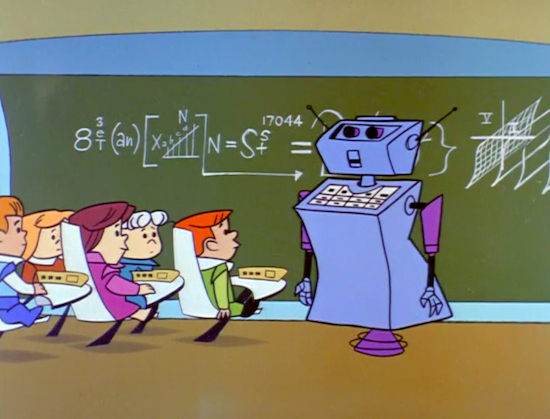
The Dystopic Future of Education Is Here

What an eye-opening week for higher education! Thanks to the folks at EdX, computers will soon be grading college papers. 

"The system then uses a variety of machine-learning techniques to train itself to be able to grade any number of essays or answers automatically and almost instantaneously.
The software will assign a grade depending on the scoring system created by the teacher, whether it is a letter grade or numerical rank. It will also provide general feedback, like telling a student whether an answer was on topic or not." 
It's true that I'm somewhat tempted by this; I'm looking at a very large stack of papers to grade this weekend. But this sounds like a bad idea for two reasons: The first is that offering feedback about whether  a paper is "on topic or not" is not particularly helpful for a student who needs to learn critical thinking skills. Mastering a particular topic or some information is far less important than mastery of logic and rhetoric; additionally, the latter are ultimately transferable from one kind of task to another, unlike the former. The second reason is that I don't think the increased automation of education is a good idea. Or, put a different way, I don't think it's a good idea for learning anything other than basic content.
Not only is human-graded student work going out the window, but those entire pesky universities are, too. EdX is also teaming up with Pearson, the educational testing service, to offer proctored exams for certificate credit to MOOC enrollees. Yes, the for-profit education testing service is now going to be in the business of accrediting MOOCs for students who want to get academic credit. And the Minerva Project offers the promise of a "hybrid" model--MOOCs and a residential college experience. Pay for both experiences, but without getting as much as either has to offer by itself. The privatization of college education is here to stay.

Thursday, March 14, 2013

Game of Thrones Is Better on TV

I'm teaching a course on medievalism this semester, and one of things I've assigned is an episode of "Game of Thrones" (S1E7: "You Win Or You Die"). The books are too long to assign for a course that also covers a lot of other material, but I wanted the students to grapple with questions of adaptation; visual tropes of medievalism and high fantasy; and the presence of an interactive on-line community of fans and fan sites.

Adaptation (across media, time period, or country) is one of the through-lines of the course. Students read several different versions of the story of Merlin and Viviane, compare Chrétien de Troyes' Lancelot with Jerry Zucker's "First Knight," and look at medieval and contemporary stories of outlaws and crusaders. For our "Game of Thrones" and interactive fantasy unit, the students aren't reading any of the ASoIaF books, but they are digging deep into winteriscoming.net and other fan sites and wikis to research the characters they'll see in "You Win Or You Die." I hope that this will give them at least a basic introduction into the books and some of the choices that David Benioff and D. B. Weiss made when they adapted the books for HBO. I recently re-watched both seasons over again in preparation for this unit and feel even more strongly than I did before that the tv series is more interesting, more complicated, and more pleasurable than the book series.

There are a few different reasons for this. One has to do with the different media. The books are written in alternating third person POV, which gives the reader a limited view of the action and the other characters. A tv show can't do that. Although the show does focus on particular story lines or characters from episode to episode, it generally presents the action in omniscient third person POV (though there are some first-person POV camera angles). This means that characters whom we know (in the books) only from another character's POV (like Varys, Shae, or Jorah Mormont) become, instead, characters that we know just as well as Tyrion or Dany. This shift in perspective, combined with the talented cast and direction, makes the experience of the tv show richer. Martin isn't very effective at conveying the particularities of each character's interior life in writing. But the actors are *very* good. Jorah Mormont (Iain Glen), is embittered, protective, lethal, and a true believer in Dany's claim. Nikolaj Coster-Waldau made some specific choices as an actor to indicate Jamie Lannister's internal depths (and conflicts). This makes Jamie a much more compelling character than he is in the first two books of the series.

Another leg up that the tv show has over the books also has to do with the limitations of prose in general. Martin is a meticulous world-builder, but that requires an awful lot of description and exposition. Pages and pages of it. But the incredibly high production values on the HBO show mean that the art direction and set design can stand in for much of that description, and provide a richly inhabited and fully realized visual world. Sometimes the dragons look a little cheesy, but the Wall, Winterfell, and Pyke look fantastic. The limitations of Martin's prose, in particular, is another reason the tv show is better. The show's writers have condensed plots, dispensed with minor characters, and made the emotional resonances of the characters more complex. I think this is particularly true of a number of the women characters. It's not that Martin neglected Cersei, but the writers on the show have brought out her rage at being a pawn despite her considerable acumen, and this makes her villainy more plausible. She's a more nuanced character. Instead of the bland Jeyne Westerling, we get Talisa Maegyr of Volantis--an immigrant to Westeros out of conscience. It's also clear that Catelyn Stark has a canny mind for statecraft and diplomacy.

A lot of things still happen on the tv show, but the writers and producers make sure that the events always reveal something about the characters. Melisandre's shadow-assassin murders Renly, but the show gives us a sharp scene between Loras and Margery that illustrates Margery's pragmatism and Loras' anguish. Martin's books are like sprawling, paratactic medieval chronicles, but "Game of Thrones" is like a Victorian novel: it has narrative economy, coherence, and more richly developed characters. So, if you're not watching the show because you haven't read the books yet, skip the books and start watching.

Saturday, March 9, 2013

The Quick and the Dead

Reports that the body of recently deceased Venezuelan president, Hugo Chavez, will be embalmed and placed on "permanent" display at the Museum of the Revolution have brought to mind other examples of this phenomenon. Other revered Communist leaders, such as Lenin, Mao Zedong, and Ho Chi Minh, received the same treatment after their deaths. And, of course, there are many examples of Christian saints whose bodies remain on display (or are brought out periodically). 

Placing the bodies of particularly revered or heroic figures on display has a long history. In medieval historical writing (including historical chronicle and epic poems), heroic warriors from Troy and Carthage were embalmed (sometimes with magical fluids) and preserved for eternity. Hector, the prince of Troy, was placed in the open, where his subjects could see him. In one account, the embalming fluid went in at the top of his skull, and then flowed through his veins into his extremities. 
Hector's embalmed body.
Cod. Bodmer 78, fol, 58r
-->


According to many natural philosophers, a person could not be considered fully dead until decay or putrefaction occurred. So keeping Hector perfectly "fresh" actually meant keeping him partially alive. Kind of like Han Solo in carbonite, or Wesley in "The Princess Bride."

Friday, March 1, 2013

Accusations of Vatican Corruption Are Nothing New

I've written before about how the persistent accusations against high-ranking Church officials of failing to report (or covering up) credible accusations of child rape and abuse at the hands of priests goes back to the Investiture Contest. But it wasn't until Joseph Ratzinger, formerly known as Pope Benedict XVI, retired that I realized that there are other similarities between the Catholic Church of the eleventh century and the twenty-first century. 

A fascinating interview with Vatican beat reporter John Thavis on Fresh Air shed light on all kinds of possible conspiracies, cover-ups, misdeeds, and shenanigans. Cronyism is apparently pretty common, and there are many who think that this kind of petty corruption should not be part of the Church. In 2009, the former pope revoked the excommunication of a bishop who denied the existence of the Holocaust. Clerical sex abuse scandals have rocked Belgium, Germany, the Netherlands, Ireland, and Australia; in the US, Philadelphia and Los Angeles have seen indictments and resignations of high-ranking Church officials over this same issue. Some claim that Ratzinger knew far more about the extent of the abuse, and worked to cover it up before he became pope. The former pope's former butler was tried for leaking classified Vatican documents to journalists; these leaks led to recent revelations about wire-tapping of Vatican officials and authorized by the secretariat of state.

In the eleventh century, many clerics were disgusted by the corruption and immorality they saw in Rome. Cronyism, nepotism, and simony were rampant. Some popes were accused of necromancy, fornication, theft, and even murder. Many of these accusations were politically motivated, and some were leveled at popes after their deaths. But in the eleventh (and twelfth) century, the struggle for power was between the papacy and secular powers (such as the Holy Roman Emperor). Now the struggle is taking place within the Church itself.

Wednesday, February 20, 2013

Book Announcement!

I'm pleased to announce that Medieval Robots, my book on medieval automata, will be coming to bookstores and the Internet in Spring/Summer 2014. It's official.
My cat ate my book contract.

Tuesday, February 19, 2013

Playing Those Medieval Robot Games

Google has alerted me to the fact that Starbound, a PC game that should be coming out in the next few months, contains medieval robots. The Glitch, a collective simulation of artificial, sentient, self-aware beings, were created by a god-like race to simulate the process of "civilization." But all of the experiments destroyed themselves, except for the ones that are still stuck in the Middle Ages. 

I need your help here, folks. I know nothing about gaming, but this sounds awesome. If you have any information about Starbound or its world, let me know! 

Friday, February 15, 2013

Russian Meteorite Could Provide the Next Excalibur

Intense! That Russian meteor was bananas. Apparently, the bright explosion was perhaps caused by the amount of iron in it. 
 
This meteor was unusual because its material was so hard — it may have been made of iron, the statement said — which allowed some small fragments, or meteorites, perhaps 5 percent of the meteor’s mass, to reach the Earth’s surface.

An enterprising smith could, under the right influences, forge this meteoric iron into a sword for the ages. 


Fallen to earth in a falling star, a clap of thunder, a great burst of light; dragged still smoking to be forged by the little dark smiths who dwelled on the chalk before the ring stones were raised; powerful, a weapon for a king, broken and reforged this time into the long leaf-shaped blade, tooled and annealed in blood and fire, hardened...a sword three times forged, never ripped out of the earth’s womb, and thus twice holy.... (Marion Zimmer Bradley, The Mists of Avalon)

Except that apparently Terry Pratchett has already done this.