Showing posts with label museums. Show all posts

Thursday, June 13, 2013

A Visit to Schloss Hellbrunn

I recently had the good fortune to visit Schloss Hellbrunn, outside Salzburg. The palace has one of the oldest and most extensive collections of automata and trick fountains still in evidence (and still working). It was completely enchanting and also very illuminating.

Schloss Hellbrunn was built in the early 17th century, at the command of Archbishop Markus Sittikus. It was intended to be a "summer palace"--a place for the great and good of Salzburg to spend a summer afternoon, before returning to their homes in the city. The archbishop's guests would dine al fresco in the Roman Theater, surrounded by fountains and statues. The basin in the middle of the table keeps the wine chilled. And the table and seats have hidden water jets that would soak the guests (but not the archbishop). Remember, court etiquette dictates that one cannot rise from the table unless the highest-ranking person does so first. So the archbishop would stay dry and seated, while his guests had to master their surprise and discomfort...and remain seated, no matter what.
The Royal Table in the Roman Theater.
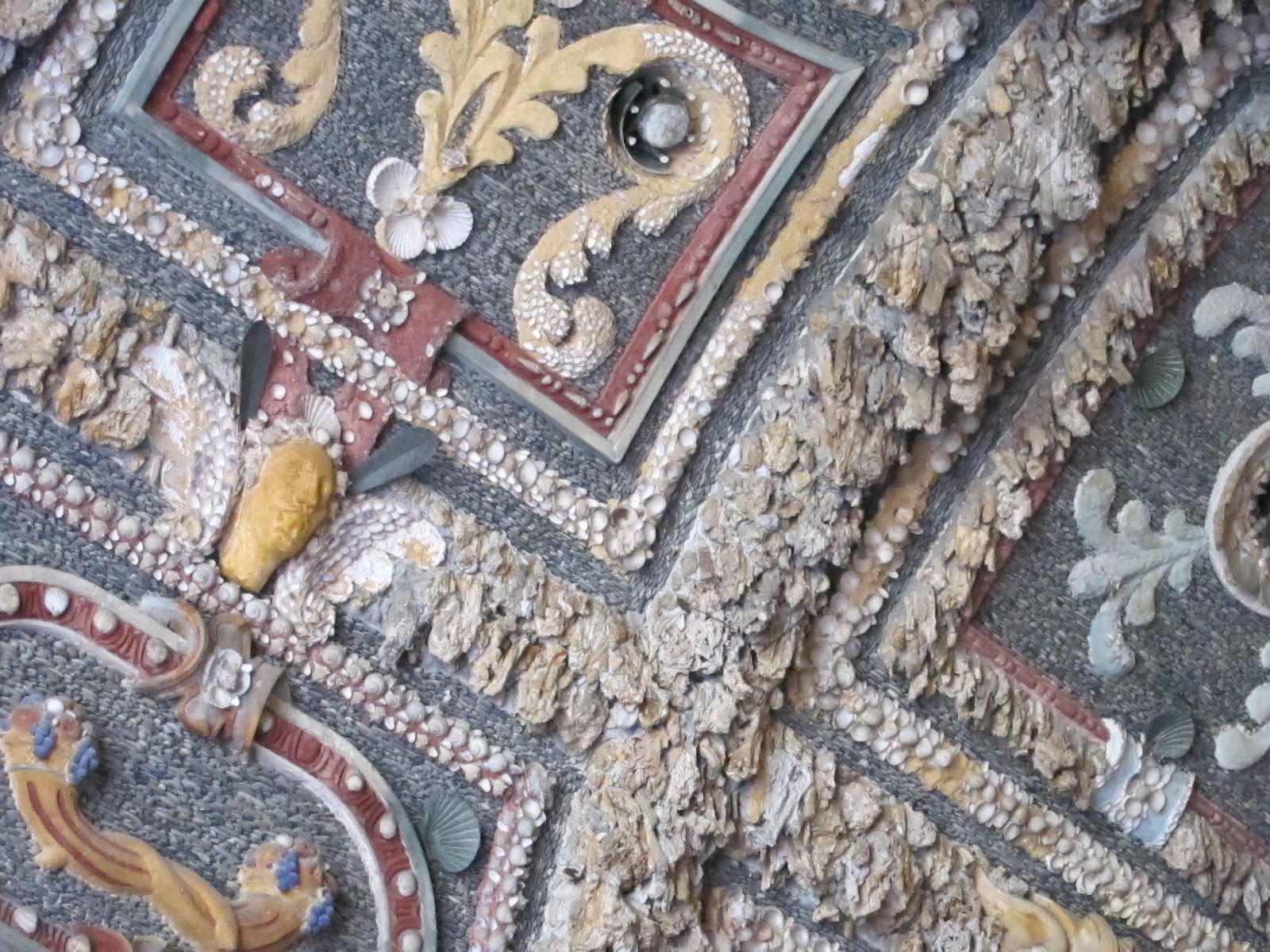
Guests could (and can) stroll into the palace grottoes, beginning with the Neptune Grotto. A statue of Neptune dominates the space, and the walls and ceiling are covered in a sort of marine mosaic, with tiny shells forming the tesserae.

A close up of the decoration in the Neptune Grotto.
At the foot of the Neptune statue, the Germaul rolls his eyes and sticks out his tongue at the visitors. This was Archbishop Sittikus' response to his critics.


Upon leaving the Neptune Grotto and the charming Germaul, you have the chance to get sprayed with water...again. And, after escaping from the grotto and standing safely outside...this happens:
Don't look up!

In fact, one of the most interesting aspects of the Wasserspiele is how they force spectators into different spaces, in the hope of escaping the water, and, of course, it just ends up being yet another opportunity for a shower. The sense of not knowing what is coming next definitely keeps people (including me) off-balance. Some of the fountains are simply lovely, like these turtles, and pose no threat to the enchanted onlooker.


Delight, amazement, uncertainty, and suspicion mingle with one another; these emotions are punctuated by bursts of Schadenfreude when an unsuspecting person gets thoroughly soaked. (For example, during my tour, the brave souls who sat at the Royal Table spent the next hour looking like they'd wet their pants.)

Along the way are small tableaux quasi-vivants, illustrating scenes of artisanal labor and Classical myth. (Blogger won't let me upload the video, so this still shot will have to do.)
This is a scene of a couple grinding scissors.
 After many other stops along the way, the final attraction is the Crown Grotto (completed after Sittikus' death in 1618). The golden crown shoots up to the ceiling, driven by a jet of water. Eventually, it comes back down, representing (I think) the rise and fall of earthly power. 
The crown falls back down. The spectators are amazed!


All of the Wasserspiele are hydraulic-powered. While much of the plumbing is now PVC (there are still some copper and lead pipes), the original pipes were made of wood.
This might be the most amazing aspect of my entire visit.


Tuesday, June 4, 2013

Check Out BBC Doc "Mechanical Marvels: Clockwork Dreams"

BBC Four just aired a cracking documentary on automata, written and presented by historian of science Simon Schaffer. It's really good, and you should watch it. It covers early clockwork machinery, jacquemarts (bell-ringers) and clockwork automata, minaturization, revolution, fraud, and the replacement of human workers with machines. I particularly liked the section on Schloss Hellbrunn (which I shall be visiting later this summer) and the way that the "Mechanical Theatre" depicts the nobility's idea of a utopian society, complete with perfectly regular laborers. Schaeffer makes some interesting connections to the fact that horological and artistic innovation rested mainly on low-paid, low-status artisanal workers; these artisanal workers ended up displacing themselves when captains of industry built machines, using the same principles as elaborate, richly decorated luxury automata, to replace human labor. 

Schaffer's expertise as a scholar is in early modern science, and he concentrates in the documentary on the automata of the seventeenth and eighteenth centuries. I have a few small emendations to offer to Schaffer's narrative. Although it's true that the regularity of clockwork machinery became used as a metaphor to understand the human body in the early modern period, early modern automata were not the first to mimic natural forms. The ancient Greeks, especially in the Alexandrian School (3rd-1st centuries BCE) designed fabulous automata (driven by pneumatics and hydraulics, rather than the verge-and-foliot escapement and falling weight drive of the early modern period) in the forms of animals and people. And Arabic engineers, in the ninth and thirteenth centuries, wrote detailed treatises on how to build programmable, musical fountains; mechanical servants; and elaborate clocks. It's also interesting to note that in the Middle Ages, descriptions of automata in narrative texts often describe them as perfect servants and as enforcers of different kinds of behavior. 

Still, the documentary is a treat, and if you're interested in automata, horology, or the history of technology, you should see it.


Sunday, November 25, 2012

A Thanksgiving Miracle

Amazing, amazing news: All of the images--all of the data--in the British Library Catalogue of Illuminated Manuscripts is now available in the public domain for non-commercial use. Thank you, thank you! Now we need the other great libraries and museums to put their manuscript images and meta-data in the public domain. One can only imagine that other institutions will be reviewing their policies in light of this game-changing development. 

Will Noel, former manuscripts curator at The Walters Museum and newly-appointed Director of Special Collections Center and SIMS at Penn, has spoken eloquently and persuasively about the benefits of making this data freely available. Digital humanities has enhanced medieval studies enormously. Making the PL and MGH searchable on-line has the potential to rejuvenate the history of ideas, and making manuscript images usable by many people promotes collaboration and scholarship and increases the net amount of delight and beauty in the world. Not bad. 

And, in honor of the feast of Thanksgiving, here's another feast:

The Meeting Of Sir Lancelot And Queen Guinevere, In 'The Romance Of Lancelot Du Lac''

The meeting of Lancelot and Guinevere, in Lancelot do lac, Royal MS 20 D.iv. British Library.


Friday, May 25, 2012

Let's Go to The Automat(a)

H. Maillardet, 1810. The Franklin Institute.

A piece in the Paris Review serendipitously echoed a conversation with a neighbor about the Morris Museum, in Morristown, NJ. First, a confession. Until my neighbor told me about it, I had *no idea* that this museum existed, or that it holds one of the largest collections of mechanical automata in the US. It's not too far from the Franklin Institute, in Philadelphia, which has a great permanent exhibit of several automata, including an early nineteenth century writing automaton by Maillardet.

I was particularly tickled by the mention of automata that simulate breathing. Adelheid (Heidi) Voskuhl has written about Enlightenment automata that appear to breathe, especially musical automata, in her upcoming book, Mechanics of Sentiment, due out later this year. Medieval automata could also appear to breathe, but in a different way. For example, in Thomas of Britain's version of Tristan and Isolde (mentioned in the previous post), the moving golden statue of Isolde has sweet-smelling herbs in its chest. The odor of the herbs travels through small golden tubes to the nose, so that when Tristan kisses it, the statue exhales scented air. This fake physiology mimics contemporary ideas about physiology, which held that the heart manufactured the spiritus (breath) necessary for life. A similar theory, in Hermetic texts, insisted on the importance of pneuma (breath) as the manifestation of the divine spirit within the individual. Well, as I live and breathe...