Showing posts with label automata. Show all posts

Thursday, October 27, 2016

Robots: Will Either Kill Us or Help Us to Death

Greetings, humans. Lots of medieval/robot news to share.

While the NYT reports that the Pentagon is confronting the reality of autonomous killing devices, a new center dedicated to ethical, computational, engineering, and social dimensions of human and machine intelligence just launched at Cambridge University. Meanwhile, San Jose airport has just installed new employees--robot "greeters" to help bewildered passengers. But why do they look female? Laurie Penny explains it all. Finally, fans of the original "Westworld" who had hoped that the new tv show would include Medieval World can continue to keep hope alive...

Wednesday, September 30, 2015

Creating Lives in "Black Mirror" and "Ex Machina"

Netflix has just announced that it will produce another dozen episodes of "Black Mirror," hallelujah. The brilliant series interrogates later-capitalist techno-modernity and the shifting boundaries between self and object--specifically, our personal computing devices. This broad topic--humanity's relationship to intelligent computers and robots--has been explored recently in the new tv show "Humans" on AMC and Alex Garland's Biblically inspired film, "Ex Machina." But "Black Mirror" tackles gender in ways that complicate and enrich the narratives of human-machine relations, and that are not replicated elsewhere.

Daniel Mendelsohn, in a superb essay out this summer in the NYRB, explored "Ex Machina," Spike Jonze's "Her," and the lineage of sentient machines in the western cultural imagination, arguing that the current crop of films and tv shows are less about machines that become like humans, and more about humans that become like soulless automatons. Mendelsohn used examples to describe both what he calls the "economic" kind of robots--machines that replace or augment human labor--and the "theological"--sentient objects made in their makers' images. Both groups of objects include those gendered as male (Talus, Frankenstein) and female (Haephestus' handmaidens, Ava). 

Many tales of the sentient machine have an erotic charge. Ava, the SAI droid in "Ex Machina," was made, like her "sisters," to fulfill her creator's sexual fantasies. Of course, this goes all the way back to Pygmalion's statue of Galatea, whom Pygmalion created, adored, and used sexually before she was "brought to life" by Aphrodite. In fact, in every example that I can think of, when this story--of the creator and his uncannily life-like creation--appears with erotic elements, the creator is male and the created object is female. 

Like "Ex Machina," "Be Right Back," the first episode of the second series of "Black Mirror" also takes up the limits of the human creator and the human-machine relationship. But unlike the other examples, the machine-being in "Be Right Back" is male, and the creator who calls him into being is female. Martha (Hayley Atwell) and Ash (Domhnall Gleeson)* move to a new house; Ash, addicted to his smart phone and social media updates, dies in a car accident; Martha discovers she's pregnant. She pays a service that mines Ash's entire online presence to create a simulacrum of him, first as a disembodied AI program, and then fully embodied in a synthetic form that is almost identical to Ash. As Martha, pregnant with Ash's child (we see them having pretty banal, and--to Martha--unsatisfying sex earlier), prepares to create a new life, she practices by bringing an old life (Ash) back. The synthetic version of Ash is eerily servile and literal-minded, but he is also an improvement on the "real" Ash in some ways. For example, he is a much more satisfying and skilled lover, something that delights and also discomfits Martha. 

By making the creator figure a woman and the object a man, Charlie Brooker, the writer, highlights the importance of gender in creation stories in a way that is ultimately far more interesting than Garland's patriarchal "Ex Machina." Martha "creates" Ash just after she discovers that she is pregnant, and key moments of bonding with the synthetic Ash occur alongside hallmarks of her pregnancy, like when she shares the first sonogram image with the disembodied AI Ash. Brooker juxtaposes the narrative of natural creation (pregnancy, baby) with artificial creation (synthetic human replacement) and asks, how are we responsible for what we create? Martha grows to regret her synthetic creation, but she cannot destroy or abandon it. Part of the reason why is hinted in the poignant coda, which shows that the synthetic Ash is still "alive," but banished to the attic, where he is visited once a year by Martha's other creation, her daughter. This "father" is the only father her daughter will know. 

*Of course, Domhnall Gleeson is the sacrificial Caleb in "Ex Machina."

Monday, January 27, 2014

Do People Even Like Robots?

It's nice to be able to invite a guest to your wedding and know that he or she isn't going to make a terrible speech or throw up on the wedding cake. On the other hand, it's also nice to be able to invite a guest to your wedding and know that he or she isn't going to make the other guests feel awkward and uncomfortable, merely by showing up. 

This is the dilemma posed by robot wedding guests, and I learned about this thanks to the recent article in the "Vows" section of the New York Times. Ideally, the robots act as telepresence proxies for guests who can't attend, but still want to be a part of the festivities (although at least one enterprising couple had a robot officiate the ceremony). Of course, the downside is that people still aren't that comfortable interacting with robots, so once the novelty wears off they are largely ignored. 

As men pulled their dates to the dance floor in Australia, Mr. O’Neill watched from Canada sitting at his computer dressed in a suit with a beer in hand, and was able to see what was happening only right in front of the seat where his brothers had propped up the robot.
“I was unconsciously turning my head to talk to people and realizing I’m in a cold, dark basement and it’s 1 in the morning,” he said.

This reminded me of the first episode of season 5 of The Good Wife. I think the callous behavior that the LG employees show toward "Monica" (a co-worker who interfaces with the firm via telepresence robot) emphasizes both the way that certain technologies destabilize social norms and disrupt communication (even--or perhaps especially--if that technology is supposed to enhance communication) and the generally toxic environment at LG.

Compare these examples, in which the human-robot interactions never become truly functional or integrated, with "Robot & Frank," in which the robot and protagonist forge a bond that is as emotionally complex as the one that Frank has with his children. It may be that "The Good Wife" is simply a more accurate reflection of how people feel about robots right now, and "Robot & Frank" is speculative fiction about a near-future in which robots are a little more responsive, a little more common.

More interesting still is that the telepresence robot in "The Good Wife" and some of the examples in the NYT article strongly resemble the descriptions of the wheeled tripodal servants that Haphaestus forged to serve the gods on Mt. Olympus. Indeed, perhaps our longstanding association between "robots" and "servants/slaves" is what makes us react to robotic avatars with discomfort, since they violate that association.

Friday, November 8, 2013

Robots from Days Gone By

Amazing automata from ye olden times have been cropping up everywhere recently! The New York Times recently ran an article about the creations of R. J. Wensley, a robotics engineer and inventor from the first half of the 20th century.* And then the folks at Colossal got excited about Simon Schaeffer's recent (and fabulous) BBC documentary, and a few of the 18th century automata that he profiles. One of these, L'écrivain, is from the workshop of Pierre & Henri-Louis Jaquet-Droz. Adelheid Voskuhl has a recent piece in Slate about the importance of the Jaquet-Droz and other Enlightenment
automata.Voskuhl's argument, based on her recent (and fabulous) book Androids in the Enlightenment, is that these luxury objects actually modeled new forms of civic engagement and social behavior by performing affective practices that were important to bourgeois and aristocratic Enlightenment culture. These automata, especially the piano-playing women that Voskuhl focuses on in her book, are conceptually similar to the 16th century praying monk, commissioned by King Charles V of Spain, that demonstrated  proper devotional practice, and to the imaginary figures from the Alabaster Chamber in the 12th-century Roman de Troie, which enacted and enforced courtly behavior.


* While I'm always happy to see Leonardo get name-checked, esp. in relation to early automata, it goes without saying that the *entire point of this blog* is to make it clear that these objects were imagined and built well before the fifteenth century.

Thursday, August 8, 2013

The Alpha and Omega of Human Artifice

H/t to MB, one of Medieval Robots' LA correspondents, for drawing my attention to this mind-blowing ad for the Omega Co-Axial Chronometer. For those of you not completely au courant with horological developments in recent decades, Omega introduced the Co-Axial escapement in 1999, when it was the first new significant development in mechanical watch movement technology in centuries.* 

Visually similar to the opening credit sequence to "Game of Thrones," the ad also hits some important and longstanding themes from the intersection of art and technology, especially horological timekeeping. The opening VO neatly encapsulates the possibility of human art perfecting (or perhaps surpassing) nature. The visuals, which meld natural and technological "movements" of different kinds, recall Martin Kemp's observation about the permeable boundaries, in Gothic and Renaissance art, between art and nature. And the final image of the mechanical orrery makes it clear that timekeeping--even in a wristwatch--is a way of mimicking the perfect movements of the heavens. 

*The escapement is the mechanism that allows for the stored potential energy (in the case of a mechanical wristwatch, this energy is usually generated from winding a spring) to be released in regular increments.

Thursday, June 13, 2013

A Visit to Schloss Hellbrunn

I recently had the good fortune to visit Schloss Hellbrunn, outside Salzburg. The palace has one of the oldest and most extensive collections of automata and trick fountains still in evidence (and still working). It was completely enchanting and also very illuminating.

Schloss Hellbrunn was built in the early 17th century, at the command of Archbishop Markus Sittikus. It was intended to be a "summer palace"--a place for the great and good of Salzburg to spend a summer afternoon, before returning to their homes in the city. The archbishop's guests would dine al fresco in the Roman Theater, surrounded by fountains and statues. The basin in the middle of the table keeps the wine chilled. And the table and seats have hidden water jets that would soak the guests (but not the archbishop). Remember, court etiquette dictates that one cannot rise from the table unless the highest-ranking person does so first. So the archbishop would stay dry and seated, while his guests had to master their surprise and discomfort...and remain seated, no matter what.
The Royal Table in the Roman Theater.
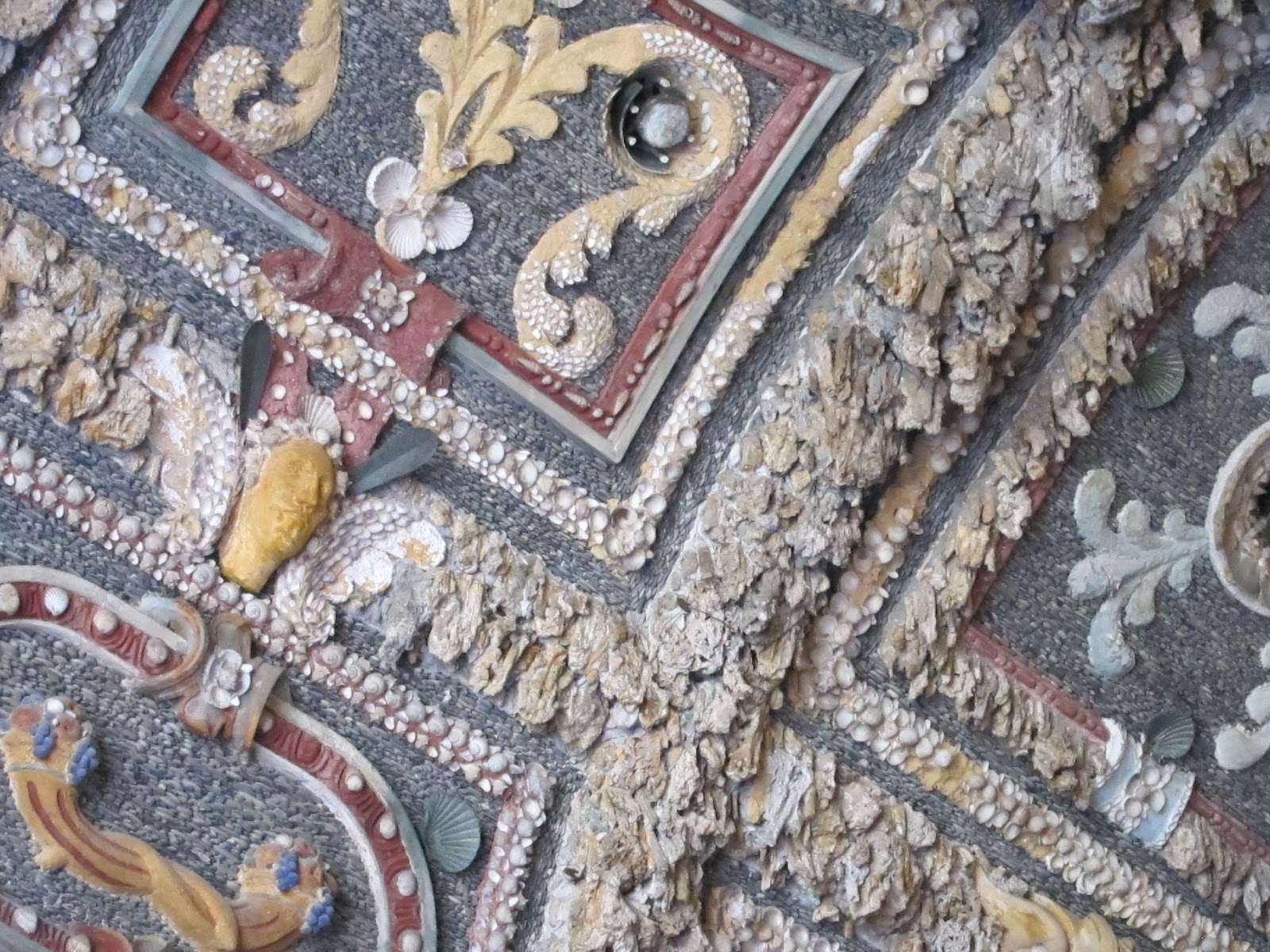
Guests could (and can) stroll into the palace grottoes, beginning with the Neptune Grotto. A statue of Neptune dominates the space, and the walls and ceiling are covered in a sort of marine mosaic, with tiny shells forming the tesserae.

A close up of the decoration in the Neptune Grotto.
At the foot of the Neptune statue, the Germaul rolls his eyes and sticks out his tongue at the visitors. This was Archbishop Sittikus' response to his critics.


Upon leaving the Neptune Grotto and the charming Germaul, you have the chance to get sprayed with water...again. And, after escaping from the grotto and standing safely outside...this happens:
Don't look up!

In fact, one of the most interesting aspects of the Wasserspiele is how they force spectators into different spaces, in the hope of escaping the water, and, of course, it just ends up being yet another opportunity for a shower. The sense of not knowing what is coming next definitely keeps people (including me) off-balance. Some of the fountains are simply lovely, like these turtles, and pose no threat to the enchanted onlooker.


Delight, amazement, uncertainty, and suspicion mingle with one another; these emotions are punctuated by bursts of Schadenfreude when an unsuspecting person gets thoroughly soaked. (For example, during my tour, the brave souls who sat at the Royal Table spent the next hour looking like they'd wet their pants.)

Along the way are small tableaux quasi-vivants, illustrating scenes of artisanal labor and Classical myth. (Blogger won't let me upload the video, so this still shot will have to do.)
This is a scene of a couple grinding scissors.
 After many other stops along the way, the final attraction is the Crown Grotto (completed after Sittikus' death in 1618). The golden crown shoots up to the ceiling, driven by a jet of water. Eventually, it comes back down, representing (I think) the rise and fall of earthly power. 
The crown falls back down. The spectators are amazed!


All of the Wasserspiele are hydraulic-powered. While much of the plumbing is now PVC (there are still some copper and lead pipes), the original pipes were made of wood.
This might be the most amazing aspect of my entire visit.