Hey folks. Medieval Robots is back from summer hiatus. After finishing a draft of The Big Book of Medieval Robots, I needed some time off to replenish my word-hoard.
Serendipitously, CT over at Brand Avenue tipped me off to the exciting world of patient simulators. Rather than actors appearing in a Beckett play (my first thought), patient simulators are physiologically accurate human robots, like SimMan2(tm). These proxy patients squirt, spurt, secrete, excrete, expel, discharge, and produce a range of fluids and solids (including a baby and placenta), and display subtle symptoms (changes in pupil dilation, respiration, temperature, etc.) that correspond to a variety of medical situations. They're increasingly used in training physicians and nurses.
One can only hope that they will appear in a horror film before too long. I can see it: a group of residents gets locked in the skills lab overnight, just as the hospital is evacuated for some compelling reason. The simulators attack the residents, subjecting them in turn to the same torture they have inflicted. The residents must use their skills to save one another, but realize that their time spent in the artificial environment of the lab has made them ill-equipped to treat actual people. Obviously, all except for two of the residents die, the sims are destroyed, and the surviving doctors swear to practice only on human patients.
But doctors have practiced on patients that they deemed less than fully human for some time. J. Marion Sims, widely regarded as the father of modern gynaecology, perfected a surgical repair for vesicovaginal fistula by operating repeatedly, and without anaesthesia, on a trio of slave women. Once he had perfected his technique, he used anaesthesia on his Caucasian patients.*
*Sims is a controversial figure. You can start reading about him here and here.
Wednesday, July 18, 2012


Friday, June 15, 2012
Black Death PSA: Stay Away from Vermin
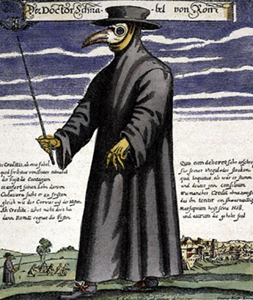
An Oregon man has been hospitalized in Bend with a disease that appears to be caused by Y. pestis, aka the Black Death. He got it after trying to rescue a mouse from the mouth of a stray cat. People, just stay away from the things cats put in their mouths. Also, beware of mice, rats, and other rodents, including squirrels (esp. in northern CA, which has seen a rash of squirrel deaths caused by the plague). They carry fleas that can transmit the disease.
I wonder if the man's doctor had to wear protective gear, like this:

I wonder if the man's doctor had to wear protective gear, like this:
Wednesday, June 6, 2012
What Is Dead May Never Die
 |
| Yes. |
"People believed the rod would pin the dead into their graves to prevent them from leaving at midnight and terrorising the living."
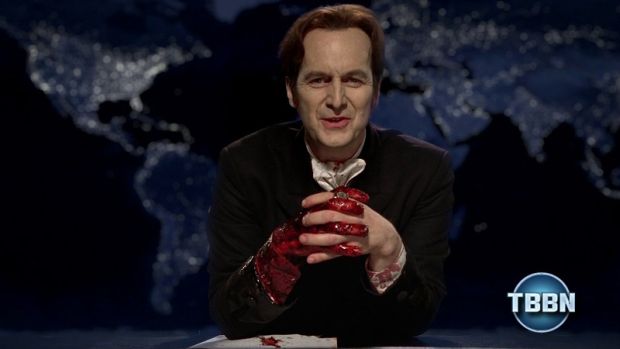
Regional customs for dealing with vampires vary. In Venice, those suspected of vampirism were buried with a brick between their teeth (this is confusing to me, as it suggests that vampirism could be detected before someone died).
 | |
| More yes. |
Musings on the Transit of Venus
The transit of Venus yesterday has me thinking about rare celestial phenomena and their meanings. It was incredibly cool to read about people viewing the transit and also to watch the NASA live webcam. I watched the transit from my sitting room in London, as the 100% cloud cover made it impossible to see. (The first transit to be recorded was by an Englishman, Jeremiah Horrocks, who saw it while he was actually in England. Talk about a lucky break, given the weather here.) That was my last chance, unless I live to see 2117 (doubtful).
All of the news coverage I saw referred to the importance of this predictable astronomical event in terms of helping astronomers ascertain more precise information about the Sun. One of the astronomers on the NASA feed talked about how the transit could end up causing disturbances in Earth's electromagnetic field, perhaps leading to patchy cell phone coverage (AT&T, you finally have a legit excuse!).
Medieval astronomers and scholars thought that celestial bodies emitted cosmic rays absorbed by Earth. These rays had measurable effects on earthly bodies, especially plants and minerals. Certain plants harvested while certain planets or stars were ascendant would have particular potency. Minerals, especially gemstones, would be imbued with particular powers by cosmic rays. William of Auvergne, a scholastic philosopher of the early thirteenth century explained the link between gemstones and celestial bodies:
…they [planets] might be collections of lights in parts of heaven itself, just as it appears among us in certain gems. For in fact I recollect when I saw an emerald, which in brilliance it appeared three shining stars. And this is true of the stone that is called heliotrope, because it is itself a green stone, growing brilliant red by means of a star… (De universo, 1.1.42).
And rare celestial phenomena were believed to portend important events on earth. Halley's Comet appeared over England in 1066, portending Harold's defeat at the hands of William the Bastard. Though now that I've experienced how difficult it is to see any celestial bodies over England, given the cloud cover, I'm beginning to wonder if the whole thing hasn't been completely made up.
All of the news coverage I saw referred to the importance of this predictable astronomical event in terms of helping astronomers ascertain more precise information about the Sun. One of the astronomers on the NASA feed talked about how the transit could end up causing disturbances in Earth's electromagnetic field, perhaps leading to patchy cell phone coverage (AT&T, you finally have a legit excuse!).
Medieval astronomers and scholars thought that celestial bodies emitted cosmic rays absorbed by Earth. These rays had measurable effects on earthly bodies, especially plants and minerals. Certain plants harvested while certain planets or stars were ascendant would have particular potency. Minerals, especially gemstones, would be imbued with particular powers by cosmic rays. William of Auvergne, a scholastic philosopher of the early thirteenth century explained the link between gemstones and celestial bodies:
…they [planets] might be collections of lights in parts of heaven itself, just as it appears among us in certain gems. For in fact I recollect when I saw an emerald, which in brilliance it appeared three shining stars. And this is true of the stone that is called heliotrope, because it is itself a green stone, growing brilliant red by means of a star… (De universo, 1.1.42).
And rare celestial phenomena were believed to portend important events on earth. Halley's Comet appeared over England in 1066, portending Harold's defeat at the hands of William the Bastard. Though now that I've experienced how difficult it is to see any celestial bodies over England, given the cloud cover, I'm beginning to wonder if the whole thing hasn't been completely made up.
 |
| Halley's Comet, in the Bayeux Tapestry. |
Friday, May 25, 2012
Let's Go to The Automat(a)
 | ||
| H. Maillardet, 1810. The Franklin Institute. |
I was particularly tickled by the mention of automata that simulate breathing. Adelheid (Heidi) Voskuhl has written about Enlightenment automata that appear to breathe, especially musical automata, in her upcoming book, Mechanics of Sentiment, due out later this year. Medieval automata could also appear to breathe, but in a different way. For example, in Thomas of Britain's version of Tristan and Isolde (mentioned in the previous post), the moving golden statue of Isolde has sweet-smelling herbs in its chest. The odor of the herbs travels through small golden tubes to the nose, so that when Tristan kisses it, the statue exhales scented air. This fake physiology mimics contemporary ideas about physiology, which held that the heart manufactured the spiritus (breath) necessary for life. A similar theory, in Hermetic texts, insisted on the importance of pneuma (breath) as the manifestation of the divine spirit within the individual. Well, as I live and breathe...
Monday, May 14, 2012
Relations with Medieval Robots
Last week, Slate published an article about the technological developments that make it more likely that humans will interact with robots with more intimacy (emotional and sexual). Some of this ground has already been covered in "Lars and the Real Girl," even though Bianca, the "girl," was a sex doll, not a robot. But, as Daniel Wilson points out, David Levy wrote presciently about this in Love and Sex with Robots (2007). Certainly, it seems like this is a zeitgeist-y topic: the summer "offbeat buddy comedy" "Robot and Frank" addresses the relationship between an aging man and his robot caretaker.
I've been thinking about this quite a bit recently, as I'm currently working on a book chapter that deals with this very issue. While the Pygmalion myth was pretty well known in medieval Europe, I find myself more fascinated by rarer stories of men who fall in love with artificial humans--often copies of recognizable individuals. In one version of the Tristan story, Tristan commands a giant in his debt to make golden statues of Isolde, her serving maid, her dog, and the dwarf who betrayed her to King Mark. Tristan can no longer see Isolde, but is still under the influence of the love-potion. So he uses these golden, moving statues to re-enact his affair with Isolde, and speaks to the statue as if it is his real lover.
The increased interest in intimate relationships between robots and people makes me wonder if the next step (presaged by the 12th century Tristan story) is robotic copies of actual people, who can replace their human analogues. Medieval is the new modern, people!
I've been thinking about this quite a bit recently, as I'm currently working on a book chapter that deals with this very issue. While the Pygmalion myth was pretty well known in medieval Europe, I find myself more fascinated by rarer stories of men who fall in love with artificial humans--often copies of recognizable individuals. In one version of the Tristan story, Tristan commands a giant in his debt to make golden statues of Isolde, her serving maid, her dog, and the dwarf who betrayed her to King Mark. Tristan can no longer see Isolde, but is still under the influence of the love-potion. So he uses these golden, moving statues to re-enact his affair with Isolde, and speaks to the statue as if it is his real lover.
The increased interest in intimate relationships between robots and people makes me wonder if the next step (presaged by the 12th century Tristan story) is robotic copies of actual people, who can replace their human analogues. Medieval is the new modern, people!
Wednesday, May 2, 2012
Automata Restoration: Hibernian Edition
H/t to two friends of Medieval Robots, PM and JR, for the heads-up about this recent BBC story about Michael and Maria Start. Michael Start was the resident expert for the automata-related aspects of the film Hugo, and is a trained horologist, while his wife, Maria Start, is a sculptor. The Starts operate The House of Automata, which specializes in restoring automata (mainly late 18th-20th century, from what I can glean from the website). The House also houses a small museum of automata, which you can visit the next time you're in Kinloss, Scotland.
Subscribe to:
Posts (Atom)